
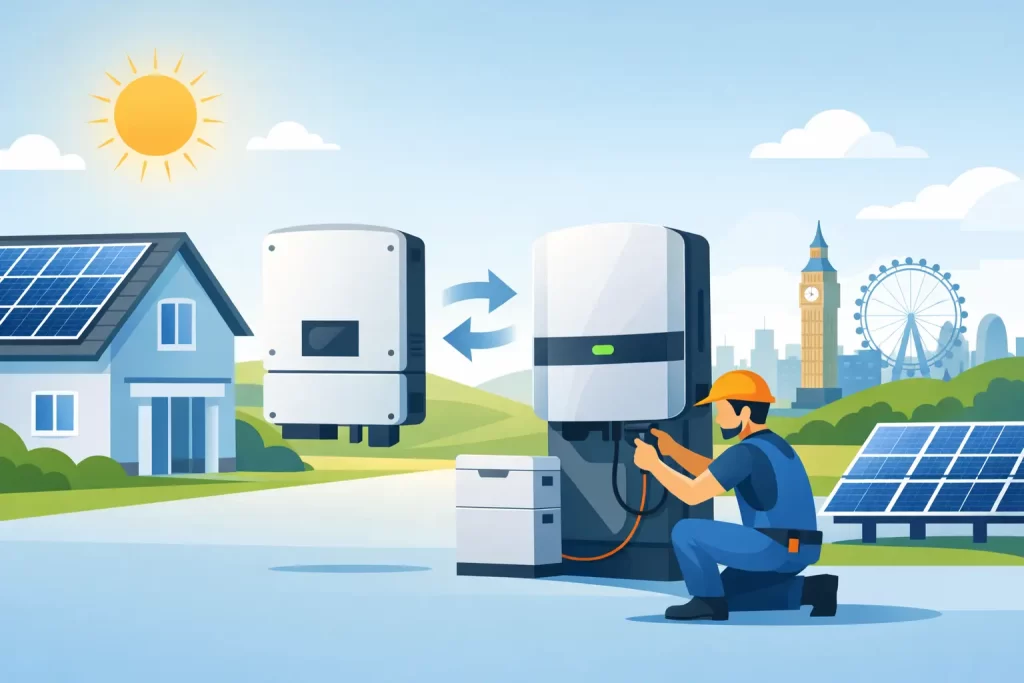
A failed inverter can turn a productive solar PV system into an expensive roof ornament. The best solar inverter replacement options are not simply about choosing the cheapest compatible box. They depend on your panel layout, generation goals, existing export arrangements and whether you want to add a battery now or later.
For many UK homeowners, the inverter is the first major solar component likely to need attention. Most have a working life of roughly 10 to 15 years, although heat, poor installation, ventilation problems and grid issues can shorten that considerably. A proper replacement should restore safe generation, protect your income from exported electricity and avoid creating a new fault where an old one has just been removed.
First, confirm that the inverter is actually at fault
A red fault light or a blank display does not automatically mean the inverter has failed. Tripped AC or DC isolators, damaged cabling, a failed communication unit, low string voltage, grid overvoltage and roof-side problems can all stop a system generating.
This matters because replacing an inverter without diagnosing the cause can waste money. For example, an inverter repeatedly shutting down at midday may be reacting to high local grid voltage, not reaching the end of its life. Fitting another unit without checking supply voltage, cable runs and settings may leave you with the same frustrating result.
A competent solar specialist should inspect the full system: panel strings, connectors, isolators, earthing, consumer unit protection, inverter logs and generation history. They should also look for poor previous workmanship, water ingress and unsafe equipment. Solar DC circuits are not a handyman job. They remain live whenever daylight reaches the panels.
Best solar inverter replacement options for UK homes
Like-for-like string inverter replacement
A like-for-like replacement is often the most sensible route where the panels, roof layout and household energy use have not changed. A modern string inverter can be matched to the existing array’s voltage and current limits, then connected to the same basic system configuration.
This is usually the most cost-effective option for a straightforward failure. It suits a system with two clean, unshaded roof aspects and panels that are still performing well. The key word is matched. Inverter capacity, maximum DC input, start-up voltage and number of MPPT trackers must suit the array, rather than being selected on brand name or price alone.
Do not assume that a larger inverter is automatically better. An oversized inverter can be inefficient at lower generation levels, while an undersized unit may clip useful output during strong summer conditions. The correct sizing comes from system measurements and design, not guesswork.
A battery-ready hybrid inverter
If battery storage is part of your plan, a hybrid inverter is often the stronger long-term replacement choice. It combines solar inversion and battery charging control in one unit, allowing a compatible battery to be installed immediately or added later.
This can reduce the disruption and cost of fitting separate battery equipment in future. It also gives you a clearer route to storing daytime solar for evening use, when household demand often rises and grid electricity is more expensive.
There are trade-offs. A hybrid inverter may cost more than a standard string inverter, and not every existing solar array is an ideal fit. Battery compatibility, available wall space, ventilation, cable routes and your household’s consumption pattern all need checking. If backup power is important, ask specifically about it. Many battery systems do not keep the house powered during a power cut unless they are designed and installed with dedicated backup equipment.
Separate solar inverter and AC-coupled battery
Keeping a standard solar inverter and adding an AC-coupled battery is another practical option, particularly for established systems where the existing panels are performing well and battery flexibility matters.
In this arrangement, the solar inverter continues to convert panel output as normal, while the battery system charges from the AC side of the home. It can be an effective way to upgrade in stages and may offer a wider choice of battery products.
The downside is that energy can undergo additional conversion when it is stored and used, creating modest efficiency losses compared with a well-designed DC-coupled hybrid arrangement. It also means two sets of equipment to accommodate, commission and maintain. That is not necessarily a reason to avoid it, but it is a reason to have the system designed properly.
Optimiser or microinverter upgrade for difficult roofs
If your old system suffers from partial shading, mixed roof pitches, different panel orientations or one weak panel dragging down a string, replacing the central inverter alone may not solve the real performance problem. In those cases, panel-level electronics may be worth considering.
Optimisers work with a compatible central inverter to manage individual panel performance. Microinverters are fitted at panel level and convert power on the roof. Both approaches can improve visibility and reduce the impact of shading or mismatch, but they involve more roof work and higher upfront cost.
They are not automatically the best answer for every property. A simple, unshaded roof with healthy, evenly matched panels may gain little from the extra equipment. On a complicated roof, however, the improvement in usable generation and fault visibility can justify the investment.
What must be checked before a replacement is fitted
An inverter change should be treated as an electrical and solar design job, not a plug-and-play appliance swap. Before work begins, the installer needs the panel make and model where available, string configuration, open-circuit voltage, operating current, inverter location, cable condition and protective devices.
They should also establish whether your system is on a legacy Feed-in Tariff, receives Smart Export Guarantee payments, or has an export limitation. Replacing an inverter does not usually mean losing a Feed-in Tariff, but records, meter arrangements and notifications matter. Keep your existing paperwork and generation evidence safe.
Grid compliance is equally important. The replacement must be commissioned to the appropriate UK connection requirements, typically G98 for smaller installations or G99 where the system falls outside those limits. If battery storage, export control or a larger inverter is being added, the Distribution Network Operator may need to be notified or approve the change before installation.
A quality installation also includes correct AC and DC isolation, suitable circuit protection, sound earthing and a sensible location. Inverters need ventilation and should not be squeezed into a hot loft, damp outbuilding or poorly sealed cupboard simply because it is out of sight. Heat is one of the quickest ways to shorten electronic equipment life.
Avoid the false economy of a cheap replacement
Cheap inverter replacements often look attractive because the unit itself is only part of the visible price. The hidden cost appears later: incompatible settings, no proper testing, poor cable management, missing paperwork, inadequate protection or an installer who cannot return when a fault develops.
Be cautious if someone offers to replace an inverter without inspecting the array details or testing the system. Equally, be wary of a quote that promises a particular generation increase without addressing shading, dirty panels, bird nesting, damaged connectors or degraded modules. An inverter can only convert the energy it receives.
Ask what is included in the work: fault diagnosis, removal and responsible disposal of the old unit, electrical testing, commissioning, monitoring setup, grid notification, warranty registration and handover documents. The answer should be clear. Vague promises are not a maintenance plan.
Choose for the next decade, not just this week
The right replacement is the one that fits the system you own and the home you are moving towards. A straightforward like-for-like inverter may be ideal for a healthy array with no plans for storage. A battery-ready hybrid model can make more sense where evening electricity use is high or a battery upgrade is close. Difficult roofs may need a more fundamental redesign rather than another central inverter.
Safer Solar UK approaches inverter replacement as part of the whole system, because a new unit should not be used to hide old faults. A careful survey, correct specification and safe commissioning give your solar PV the best chance of generating reliably for years to come.