
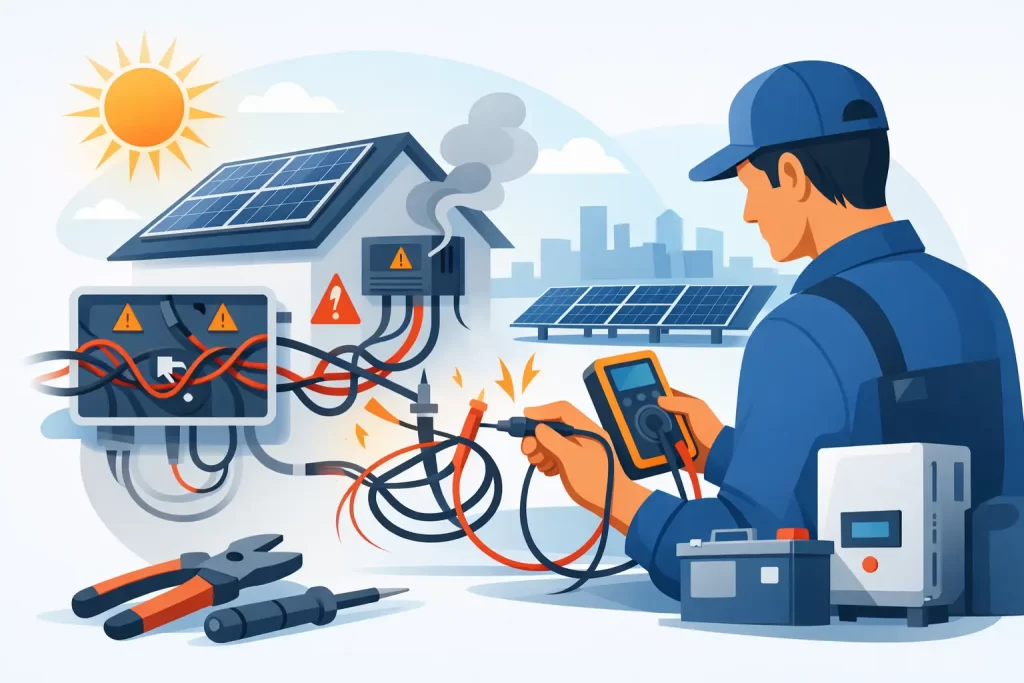
A homeowner contacted us after noticing that a solar PV system installed only a few years earlier was producing far less electricity than expected. The inverter was still operating, no obvious fault code was showing, and the panels looked fine from ground level. This incorrect solar wiring case study shows why a system that appears to be working can still have serious defects hidden beneath the panels, in the loft or around the inverter.
The issue was not dirt on the modules or normal seasonal variation. It was poor electrical workmanship: unsuitable cable routing, unprotected DC cabling and connections that had not been properly checked as part of commissioning. Left alone, the faults could have caused further generation losses, water ingress and a very real electrical safety risk.
The call-out: low generation without a clear alarm
The property had a medium-sized roof-mounted array and an inverter that continued to report normal daytime operation. From the homeowner’s perspective, that made the poor output confusing. They could see generation, but it did not match previous years or the expected performance for a clear day.
This is where cheap diagnosis often fails. A quick glance at an inverter screen does not prove that a solar PV system is safe, correctly wired or operating at its potential. The inverter can remain powered while one string is compromised, a connector is overheating or DC cable insulation is being damaged where it passes across the roof.
Our inspection began with the system records, inverter data and a visual check of the array, cable routes, roof penetrations and isolators. We then carried out appropriate electrical testing to identify where the losses were occurring. Testing must be planned and undertaken safely. Solar cables can remain live whenever light reaches the panels, even when an inverter has been isolated.
Incorrect solar wiring case study: what we found
Several problems had developed from the original installation. None should have been accepted as finished workmanship.
The DC cables had been routed in a way that allowed sections to sit against roof materials and sharp fixing points. Solar cable insulation is designed for outdoor use, but it is not indestructible. Repeated movement in wind, heat cycling and abrasion can wear it down over time. Cables should be securely supported, protected from damage and routed with the whole roof and PV system in mind.
We also found poorly managed connector locations. PV connectors need to be compatible, correctly crimped, fully engaged and kept out of areas where they can sit in standing water or be subjected to unnecessary strain. A connector that looks joined is not automatically a sound connection. Poor crimping or mixed connector types can create resistance, heat and intermittent faults that are difficult to spot without proper testing.
The cable entry into the property had not been finished to the standard expected for a weatherproof installation. The seal and route needed attention to reduce the risk of water tracking into the roof space. This is not simply a cosmetic issue. Water ingress around solar cable entries can affect insulation, timber and the electrical components below.
Finally, the system labelling and isolation arrangement required improvement. Clear labels help homeowners, electricians and emergency services understand what supplies are present and how the system should be isolated. They are part of a safe, maintainable installation, not an optional extra.
Why the inverter did not tell the full story
An inverter monitors key operating values, but it cannot inspect the physical condition of every cable, roof penetration or connector. Depending on the system design, it may not identify a developing high-resistance connection until output has already fallen or the condition has worsened.
There is also a difference between a system that is generating and a system that is generating correctly. If a roof has two strings with different levels of fault or shading, the total figure may look believable to a homeowner who has no baseline for comparison. That is why historic generation data, string-level checks and a physical inspection matter.
The repair: correcting the fault properly
The repair was not a case of taping a cable and walking away. Solar PV work must address the cause, not just the visible symptom.
We made the affected DC side safe, removed and replaced compromised cable sections, and rerouted the wiring so it was properly supported and protected. The cable route was kept clear of abrasive points and arranged to avoid unnecessary strain. Any connections that did not meet the required standard were replaced with suitable components and correctly terminated.
The roof entry was also rectified and resealed using an approach appropriate to the roof covering and cable route. This was checked alongside the mounting system, because electrical repairs should never ignore the roof details that protect the home underneath.
Once the remedial work was complete, the system was tested again before being returned to service. The homeowner was given a clear explanation of what had been found, what had been repaired and what to monitor going forward. That level of handover matters. You should not be left with a technical repair and no understanding of how it affects your system.
What incorrect solar wiring can cost a homeowner
The immediate cost is often lost generation. When a system underperforms, the household buys more electricity from the grid than it should. For homes receiving export payments or older tariff-based income, reduced output can also affect the financial return from the system.
The bigger concern is that electrical faults can worsen. Heat caused by resistance at a poor connection can damage connectors, cable insulation and nearby materials. Damaged insulation can expose conductors to moisture. Poor roof penetrations can lead to leaks that are only discovered once staining appears in a bedroom ceiling or loft.
Not every low-output system has a wiring fault. Heavy shading, failed optimisers, inverter problems, soiling, bird activity and a changed household consumption pattern can all be part of the picture. But wiring and connector defects must be ruled out by a competent solar specialist, particularly where the original installer is no longer trading or the workmanship was clearly rushed.
Signs your solar wiring needs inspection
Homeowners do not need to go onto a roof or open electrical enclosures to recognise warning signs. A sudden unexplained drop in generation, repeated inverter warnings, tripping equipment, a burning smell near the inverter or isolators, visible loose cables, and any sign of water around cable entry points all justify a prompt professional inspection.
Take a closer look at trends too. Compare similar months year on year, allowing for weather differences. If output has gradually slipped without a clear reason, do not assume the panels simply need cleaning. Panels may be soiled, but the cause could be a developing electrical issue or a bird-related problem beneath the array.
Do not rely on a general handyman
Solar PV combines roof work and DC electrical systems. A person may be confident on ladders or competent with household electrics, yet still lack the knowledge to assess module strings, compatible PV connectors, cable management, roof mounting and safe isolation together.
That is why remedial work needs a specialist approach. The right contractor should investigate the system as a whole, use suitable materials, explain the findings plainly and test the work before declaring the problem solved. A low quote that replaces one visible part while ignoring cable routing, roof integrity or commissioning checks can leave the underlying risk in place.
Preventing the same problem after repair
A well-installed solar system should not need constant intervention, but it should not be forgotten either. Periodic visual checks from ground level, monitoring of generation figures and professional maintenance after storms, roof work or signs of bird activity can identify issues before they become expensive.
If you are adding battery storage, replacing an inverter or expanding an existing array, treat it as an opportunity to inspect the original PV wiring. Alterations can expose historic shortcuts that were hidden when the system was first installed. It may be more cost-effective to correct questionable cable routes and isolators while work is already being carried out than to wait for a fault.
Your solar system sits on your roof, connects to your home and handles live DC electricity whenever daylight reaches the panels. If its performance has changed or the original work gives you cause for doubt, arrange a proper inspection before a small wiring defect becomes a larger repair.