
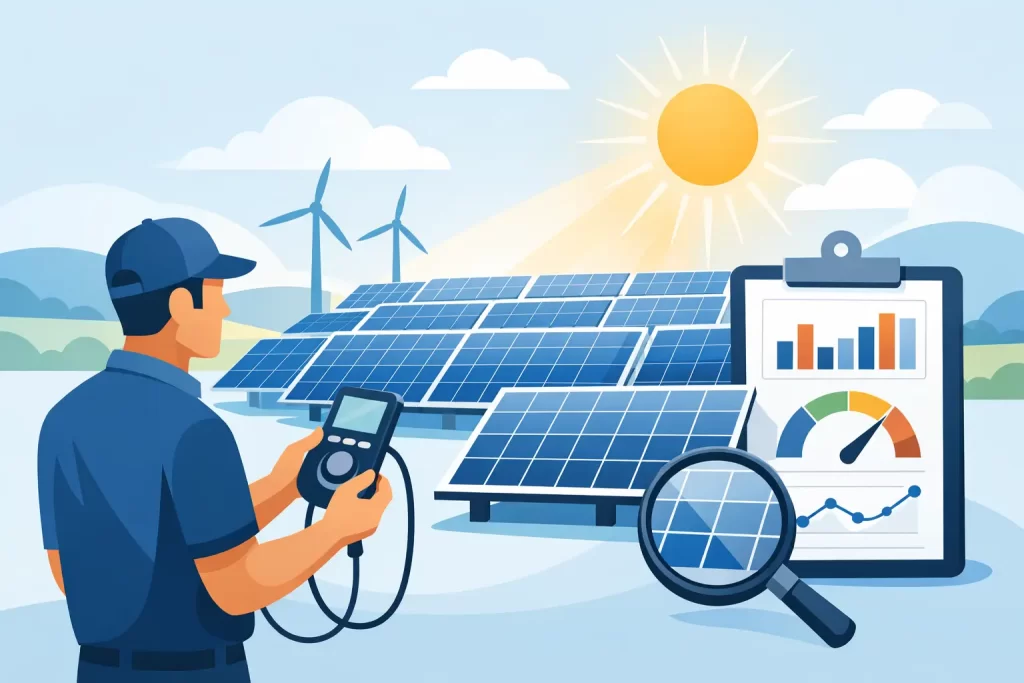
A solar PV system can look perfectly clean from ground level while quietly producing far less electricity than it should. If your bills have risen, your inverter display looks disappointing, or your generation payments have dropped, it is time to test solar output properly rather than rely on a quick glance at an app.
The key is to compare like with like. A cloudy Tuesday in November will never match a clear day in June, but unexplained changes against your system’s usual performance can point to dirt, shading, inverter problems, bird activity, damaged cabling or a poor-quality installation that has finally started to show its weaknesses.
Start with the inverter and monitoring data
Your inverter is the first place to look. Most systems show live generation in watts or kilowatts, along with total energy generated in kilowatt-hours. Check the display at different points during a reasonably bright day, ideally when there is no obvious shade across the roof.
Do not judge the system only by its peak figure. A 4 kW system is not guaranteed to produce 4 kW at every moment. Panel orientation, roof pitch, temperature, cloud cover, time of day and the age of the equipment all affect output. South-facing panels at a suitable pitch generally produce more around midday than east- or west-facing arrays, but those orientations can still perform well by spreading generation across the morning or afternoon.
What matters is whether the output makes sense for the conditions and whether it has changed significantly from similar days, weeks or seasons in previous years. If your monitoring portal records daily generation, compare a run of bright days rather than one isolated result. One poor day proves very little. A clear downward trend deserves investigation.
If the inverter shows an error code, warning light or repeated shutdown message, record it before resetting anything. A reset may bring the system back temporarily, but it does not cure an underlying fault. Repeated inverter trips, grid errors and communication failures need proper diagnosis.
How to test solar output against realistic expectations
The most useful check is your actual generation against the estimated annual yield provided at installation. This may be on your MCS paperwork, handover documents or original quotation. A system’s expected annual output is normally expressed in kilowatt-hours per year.
Annual figures are more reliable than daily figures because British weather is variable. As a broad principle, a well-sited domestic system should follow a familiar seasonal pattern: low production through winter, a steep rise in spring, strong output in late spring and summer, then a gradual fall through autumn. A system that suddenly produces 20 to 30 per cent less than its established pattern in comparable conditions should not be ignored.
Be cautious with simple online calculations. They can be useful as a rough check, but they cannot see the tree that has grown above your roof, the chimney shadow that moves across a string of panels, or the pigeon nest beneath the array. They also cannot identify a failed optimiser, a weak panel string or an inverter operating outside its normal range.
For households with batteries, separate solar generation from battery activity. A battery can make your home appear highly self-sufficient even when panel generation is weak, because it may be discharging stored electricity. Check the figures labelled PV generation, grid import, grid export, battery charge and battery discharge. These are not interchangeable readings.
Check for the common causes of lost generation
Before assuming the panels themselves have failed, inspect the obvious causes from a safe position on the ground. Moss, algae, heavy grime and bird droppings can block light, particularly when they build up in patches rather than as a light, even film. A single heavily soiled section can affect more than one panel where panels are connected in a string.
Pigeons are a more serious problem than many homeowners realise. Nesting beneath solar panels brings droppings, feathers, mites and nesting material onto the roof. It can block drainage routes, create unpleasant odours and encourage persistent contamination of the panel surface. In some cases, birds and debris can also interfere with ventilation beneath the array, which is not helpful when panels and electrical equipment need to shed heat.
Shade is another regular culprit. It may come from a neighbouring extension, a new loft conversion, satellite equipment, overgrown trees or even a chimney stack that was always there but now has a different effect because the sun sits lower in the sky. Shade across one panel can have an outsized effect on older string-based systems without optimisers or suitable panel-level controls.
Look for physical warning signs too: cracked glass, loose clamps, displaced panels, exposed cable, damaged flashing or staining around roof penetrations. Do not climb onto the roof, lift panels or touch electrical connections to investigate. Solar panels generate DC electricity whenever there is daylight. DC faults are not a handyman job and can present a real fire and shock risk if handled incorrectly.
Do not test solar output by unplugging cables
Homeowners sometimes find online advice telling them to use a multimeter on solar cables, disconnect MC4 connectors or test voltage directly at the panels. That is unsafe advice for most domestic systems.
A solar array can carry high DC voltage, and disconnecting connectors under load can cause arcing. Incorrect testing can damage connectors, compromise weatherproofing, invalidate warranties and create hazards that remain hidden until a later fault occurs. The same applies to opening an inverter or consumer unit without the right competence and test equipment.
A proper electrical diagnostic may include insulation resistance testing, string voltage and current checks, earth continuity checks, polarity verification, inverter assessment and thermal inspection. These checks are valuable because they distinguish between a dirty panel surface and a genuine electrical problem. They must be completed by a competent solar specialist who understands both PV systems and the roof on which they are fitted.
When a professional test is worth arranging
Arrange a professional inspection if output has dropped sharply, the inverter regularly reports faults, one part of the array appears to underperform, or you can see bird nesting, roof damage or contamination beneath the panels. It is also sensible to book a check before adding battery storage, replacing an inverter or upgrading an older system.
The best inspection does not start and end with a panel clean. Cleaning can improve generation where contamination is the cause, but it will not repair a failed inverter, a damaged connector, poor cable routing or a badly designed original installation. Equally, replacing equipment without identifying the real fault is an expensive way to guess.
A specialist should assess the panel condition, mounting system, roof integrity, cabling, isolators, inverter performance and available generation data. Where birds are involved, the work should address both the cleaning and the access route beneath the panels. Leaving gaps after removing nests simply invites the same problem back.
At Safer Solar UK, this is why solar fault finding is treated as more than a quick visual check. Underperforming systems often have more than one issue, especially where previous work was rushed or carried out by firms without the right solar and roofing knowledge.
Keep a simple performance record
You do not need to watch the inverter every day. Record monthly generation totals, note any inverter alerts and save screenshots when output looks unusual. If you have a battery, record its settings too, particularly after tariff changes or app updates.
This small record gives you a useful baseline. It also makes it easier for a specialist to spot whether the problem is gradual contamination, seasonal shading, intermittent equipment failure or a sudden fault that needs urgent attention.
Your solar system should be working for the lifetime of the installation, not just until the original installer leaves the driveway. A sensible check now can protect generation, prevent avoidable roof and bird problems, and give you clear evidence before a minor loss turns into an expensive repair.