
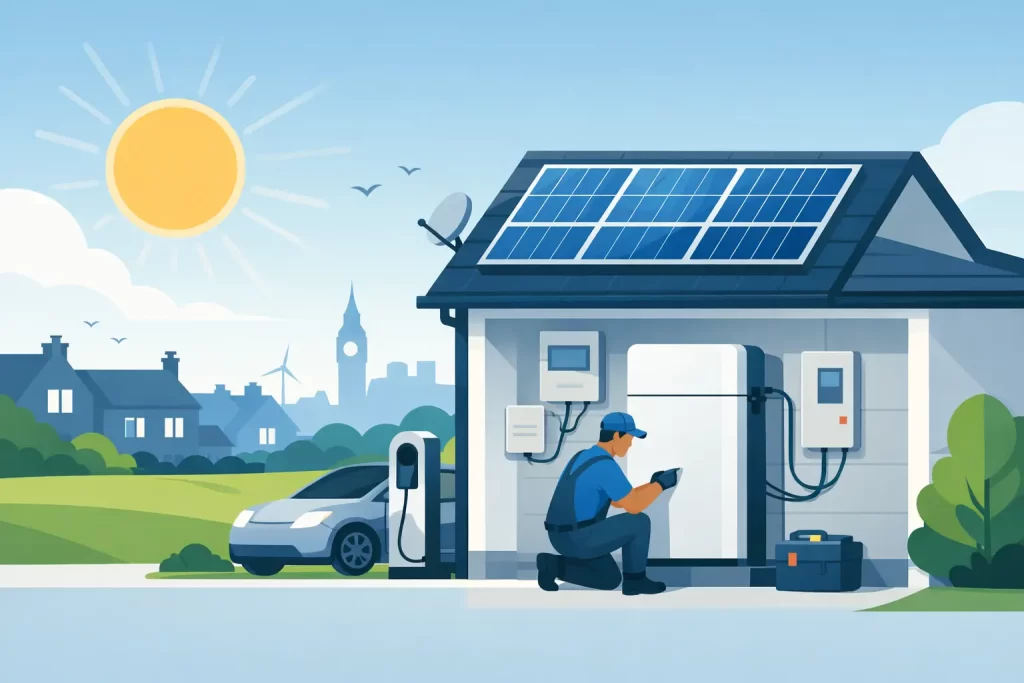
A solar system can be generating well at midday while your household buys electricity again at 6pm. That is the gap a battery is designed to address. This home battery retrofit guide explains what must be checked before adding storage to an existing UK solar PV system, and where a cheap installation can cause costly problems.
A retrofit is not simply a battery bolted to a garage wall. It has to work safely with the existing inverter, generation meter, consumer unit, export arrangement and electricity network. The right battery can increase the value of the solar you already produce. The wrong design can limit performance, create monitoring errors or leave you with a system that cannot deliver the backup capability you expected.
Is a home battery retrofit right for your system?
A battery makes most sense when a household regularly exports solar electricity during the day and imports power during the evening, overnight or early morning. It can also be useful for homes on time-of-use tariffs, where the battery can charge at a lower overnight rate and reduce electricity bought at peak times.
However, solar generation alone does not decide whether storage is worthwhile. A household that is out all day, has a modest array and low evening consumption may need a smaller battery than expected. Equally, a busy family home with an electric vehicle, heat pump or electric cooking may use stored energy quickly. Battery capacity should follow real consumption data, not a sales figure chosen because it sounds impressive.
Start with your smart meter data or electricity bills. Look at daytime export, evening demand and overnight use across different seasons. Summer generation may make a battery look exceptional, but a sound proposal also shows what happens during a grey January week when solar output is much lower.
The checks that should happen before installation
A competent installer begins with the existing system, not the battery brochure. Older solar installations vary greatly in quality, and retrofit work often exposes loose cabling, unsuitable isolators, aged inverters or undocumented alterations made after the original installation.
The installer should establish the solar array size, inverter make and model, inverter age, generation meter arrangement and any existing fault history. They should inspect the condition of DC and AC cabling, roof-entry points, isolators and the consumer unit. If panels are affected by nesting birds, damaged cables or heavy contamination, those problems should be dealt with before judging the system’s generation or adding more equipment around it.
They should also check the incoming supply and the local Distribution Network Operator requirements. Most battery installations require notification or approval under G98 or G99 rules, depending on the system design and export capacity. This is not optional paperwork. It protects the local network and prevents an installation being left non-compliant.
Four practical checks deserve particular attention:
- Solar inverter compatibility: some inverters can accept a compatible DC battery, while others cannot.
- Consumer unit capacity: protective devices, cable routes and earthing must be suitable for the additional load and generation equipment.
- Metering and monitoring: current transformers must be positioned and configured correctly or the battery may charge and discharge at the wrong times.
- Battery location: the unit needs a sound, accessible mounting surface, appropriate clearances and a route that does not compromise fire safety or future maintenance.
Any electrician can connect cables. A proper retrofit requires someone who understands how solar PV, battery controls and the home’s electrical installation behave together.
AC-coupled or DC-coupled battery storage?
For most existing solar homes, an AC-coupled battery is the straightforward retrofit route. It has its own battery inverter and connects on the AC side of the property, allowing it to monitor solar export and charge from surplus generation. It can usually be installed without replacing a working solar inverter.
That flexibility is valuable, especially where the original inverter still has years of useful life. The trade-off is that electricity may be converted more than once as it moves between solar panels, battery and household circuits. Those conversion losses are usually modest, but they should be acknowledged rather than ignored.
A DC-coupled system connects the solar panels and battery through a hybrid inverter. It can be highly efficient and tidy, but it is often more involved for a retrofit because the existing solar inverter may need replacing. If an older inverter is unreliable, out of warranty or undersized, a hybrid inverter upgrade can be sensible. If the existing inverter is performing well, replacement may add cost without producing enough extra benefit.
There is no universal winner. The best arrangement depends on equipment compatibility, the age of the solar inverter, the available budget and whether future expansion is likely.
Size the battery for usable energy and power
Battery capacity is usually quoted in kilowatt-hours (kWh), but capacity is only half of the decision. Usable capacity matters because batteries retain a protected portion to preserve cell life. A 10kWh unit does not always provide a full 10kWh for household use.
Power rating matters too. It determines how much electricity the battery can supply at one time. A large-capacity battery with a low output rating may cover background loads for many hours but struggle when the oven, kettle and shower are running together. For a home with high evening demand, this can be more frustrating than having slightly less storage capacity.
As a broad approach, assess the electricity normally used after solar generation falls, then select capacity around that pattern rather than attempting to store every possible summer surplus. Oversizing can leave part of the battery unused for much of the year. Undersizing means more grid imports, but may still offer a better return depending on tariff savings and the purchase price.
Ask for annual estimates with transparent assumptions: expected solar charging, grid charging, export foregone, tariff rates, battery losses and likely degradation. If the figures only show ideal sunny-day performance, they are not a reliable basis for a decision.
Backup power is not automatic
Many homeowners assume that a battery keeps the house running during a power cut. Standard battery systems often do not. In a grid outage, most installations disconnect for safety so they cannot energise cables being worked on by network engineers.
Backup requires specific equipment and design. This may be a protected circuits board for selected loads, such as lighting, refrigeration, broadband and a few sockets. Whole-house backup is possible in some properties, but it requires careful load assessment and sufficient battery output. Electric showers, immersion heaters, ovens and EV chargers can overwhelm a backup supply unless they are managed or excluded.
If resilience is a priority, say so before design work starts. Retrofitting backup provision later may mean additional equipment, rewiring and disruption.
Protect tariffs, warranties and long-term performance
If your solar system receives Feed-in Tariff payments, make sure the retrofit design protects accurate generation metering and does not interfere with the existing payment arrangement. Export payments, smart tariffs and battery charging rules should also be understood before commissioning. Some tariffs restrict how battery electricity is exported or require particular metering arrangements.
Battery warranties need reading beyond the headline number of years. Check the guaranteed throughput, retained capacity, labour cover, inverter warranty and whether remote monitoring is included. A battery is a long-term electrical asset, so aftercare matters when firmware updates, faults or communication issues arise.
Do not ignore the existing solar system simply because the new battery is the exciting part. A weak inverter, poor roof cable route, degraded isolator or contaminated panels can hold back the entire investment. Safer Solar UK Ltd approaches upgrades as a system check, because correcting underlying faults before installation is safer than burying them beneath new equipment.
Choose workmanship over a bargain quote
A low quote can omit the very work that makes a retrofit safe: proper isolators, suitable protective devices, compliant cable containment, DNO administration, commissioning and clear handover information. Ask who will complete the electrical work, whether it will be certified, what equipment is included and what happens if the existing installation fails inspection.
You should receive a clear design, commissioning records, operating instructions, warranty documents and confirmation of any network notification or approval. The monitoring app should be demonstrated, not merely downloaded, so you know how to see solar generation, household consumption, battery charge and grid import.
A well-designed battery should quietly earn its place in the home, storing useful energy when it is available and reducing expensive imports when it is needed. Begin with a proper inspection of the solar system you already own, and the upgrade has a far better chance of delivering savings without compromising safety.