
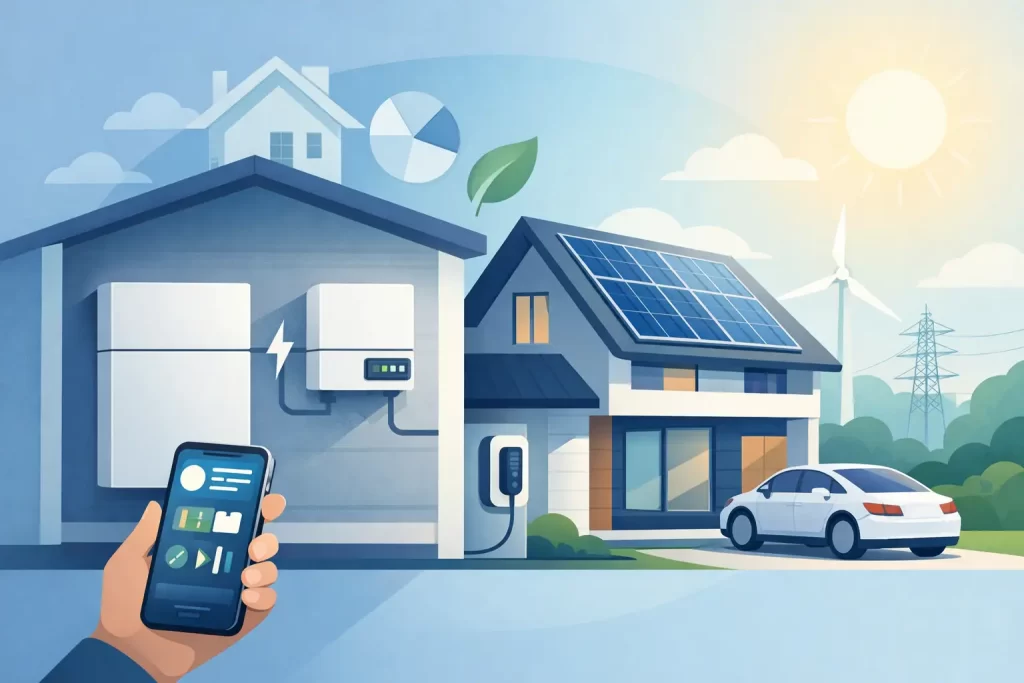
A battery that looks excellent on a sales quote can still be the wrong battery for your home. A proper home battery system review is not about chasing the biggest kWh figure or the cheapest installed price. It is about whether the system will capture your surplus solar, cover the parts of your evening demand that cost the most, work safely with your existing equipment and continue doing its job years from now.
For homes with solar PV, battery storage can be a sensible upgrade. It can reduce exported energy, increase self-consumption and make time-of-use tariffs more useful. But a poorly specified battery can sit half-used, charge too slowly, fail to support the loads you expected or create complications when an inverter fault develops. The detail matters.
Home battery system review: start with your real usage
The right battery size depends on what your household uses, when it uses it and how much solar surplus you actually have. These are not the same thing. A home that produces plenty of solar in July may have very little spare generation in December, while its electricity demand rises through darker evenings.
Look at half-hourly smart meter data where available, alongside generation data from the solar inverter. A household that regularly exports 5kWh on a sunny day and uses most of its electricity after work has a very different case for storage from a household where someone is at home using appliances throughout the day.
Be wary of simple claims that a battery will make you “self-sufficient”. In the UK, winter solar generation is limited and heating, cooking and lighting demand can be high. A battery does not create electricity. It stores surplus power when there is enough available, or, with the right tariff and configuration, charges at lower-cost off-peak times for later use.
The most useful question is not, “What is the largest battery I can buy?” It is, “How much energy can I reliably use before the battery needs recharging?” For many typical solar households, an oversized unit brings a higher upfront cost without delivering proportionally better returns.
Capacity is only half the specification
Battery capacity is quoted in kilowatt-hours (kWh). This tells you how much energy it can store, but it does not tell you how quickly the system can deliver that energy. For that, you need to look at power output, measured in kilowatts (kW).
A 10kWh battery with a modest discharge rate may cover background electricity use very well, but it may not fully support a kettle, oven, induction hob, shower pump or electric vehicle charger operating at the same time. The grid will still supply the difference. That is not necessarily a fault – it is normal – but it should be understood before installation.
Usable capacity also matters more than headline capacity. Batteries maintain a protected reserve to avoid damaging cells through deep discharge. Check how much stored energy is actually available for daily use, the minimum state of charge set by the manufacturer and whether a reserve is held back for backup operation.
For many homes, a sensible balance of usable capacity and discharge power is better than a large battery that cannot respond to household demand. The installer should explain this in plain terms, using your expected loads rather than generic promises.
Solar charging rate can limit performance
A battery needs enough charging power to make good use of surplus generation. If your existing solar array can produce 4kW to 6kW during strong sunshine but the battery accepts only a small charge rate, some energy may still be exported while the battery fills gradually.
This is particularly relevant where a system has been added onto older solar PV. The original inverter, panel layout, export limitation and connection arrangement can all affect what is possible. A site survey should establish the actual condition and specification of the existing system rather than assuming every solar installation is ready for a battery.
AC-coupled or DC-coupled: choose for the property
An AC-coupled battery is often well suited to an existing solar installation because it can be installed alongside the current solar inverter. It is a common route for retrofits and can avoid replacing equipment that is still performing correctly. The trade-off is that power is converted between AC and DC more than once during the storage cycle, which creates some efficiency loss.
A DC-coupled system connects battery storage more directly with the solar generation through a compatible hybrid inverter. It can be an efficient option when installing a new PV system or replacing an ageing inverter. However, it may involve more disruption and cost where the existing inverter has plenty of serviceable life remaining.
Neither arrangement is automatically better. The right choice depends on inverter age, available space, panel configuration, future plans and whether the existing installation has faults or poor workmanship that need putting right first. Bolting new technology onto a neglected system is not an upgrade strategy.
The savings case depends on tariff discipline
Solar batteries are often sold on the basis of storing daytime surplus for use after sunset. That is a genuine benefit, but tariff-based charging can be just as important. With a suitable smart tariff, a battery may charge when electricity is cheaper and reduce purchases during higher-priced periods.
That approach requires care. Tariffs change, standing charges still apply and export rates may sometimes make it more valuable to export solar than store it. A good system should be configured around the tariff you actually use, not left on a generic setting after commissioning.
Ask how the battery manages solar charging, grid charging, export and priority loads. Ask who will make adjustments if you change tariff. The answer should not be, “You can sort that on the app,” unless you have been properly shown how and are comfortable managing it.
Savings estimates should also allow for round-trip losses. Every time electricity is stored and released, a small proportion is lost as heat and conversion loss. Treat dramatic payback claims with caution, especially when they assume perfect sunny days, rising electricity prices and no battery degradation.
Warranty wording deserves close attention
A long warranty is reassuring only when you understand what it covers. Battery warranties commonly include a time period, a cycle limit or a throughput limit, plus a retained-capacity condition. These are not identical.
For example, a warranty may last ten years but only up to a specified amount of energy moved through the battery. It may guarantee that the unit retains a certain percentage of its original usable capacity, rather than promising it will perform as new. Read the exclusions too, particularly requirements around internet connection, ventilation, approved installation and software updates.
It is also worth checking the warranty position for every part of the installation: battery modules, inverter, gateway or backup hardware, isolators and workmanship. If a fault occurs, homeowners need to know who diagnoses it, who deals with the manufacturer and whether the original installer will still be there to support the system.
Backup power is not standard
Many homeowners assume a battery keeps the house powered during a power cut. Most standard systems do not do this automatically. For safety, grid-connected solar and battery systems normally shut down when the network supply fails unless they have correctly designed backup or islanding equipment.
A backup setup may support only selected essential circuits, such as lighting, broadband, refrigeration and a few sockets. Supporting an entire property, especially high-load appliances, requires more planning and may need substantial battery and inverter capacity.
Decide what resilience means for your household before signing a quote. If the priority is keeping a freezer, router and heating controls running, a protected essential-load circuit may be appropriate. If you expect every socket and appliance to operate as normal, the design and budget will be very different.
Installation quality protects the investment
Battery storage carries high currents and must be installed in a suitable location with correct isolation, protection, cable sizing and clear access for maintenance. The battery should not simply be fitted wherever there is an empty bit of wall. Consider ventilation requirements, fire safety guidance, escape routes, exposure to damp, likely temperatures and whether the fixing surface is suitable for the unit’s weight.
The electrical side needs equal attention. Existing consumer units, earthing arrangements, inverter condition and cable routes should be assessed before work begins. Where solar systems have been installed poorly, damaged by water ingress or left with questionable connections, those defects need resolving before a battery is added.
At Safer Solar UK, the priority is not just getting a battery on the wall. It is making sure the wider PV system is safe, correctly configured and capable of delivering the performance the homeowner is paying for.
Before accepting a quote, make sure it clearly states the usable capacity, continuous output, proposed location, backup capability, warranty terms, monitoring arrangement and what happens to your existing solar inverter. It should also explain whether any network notification or approval is required for the final design.
A battery system should earn its place in your home every day, not just look impressive on an app. Choose the installer who asks for your generation data, checks the condition of the existing installation and explains the limitations as clearly as the benefits. That is how storage becomes a long-term energy asset rather than an expensive box with a promising sales forecast.