
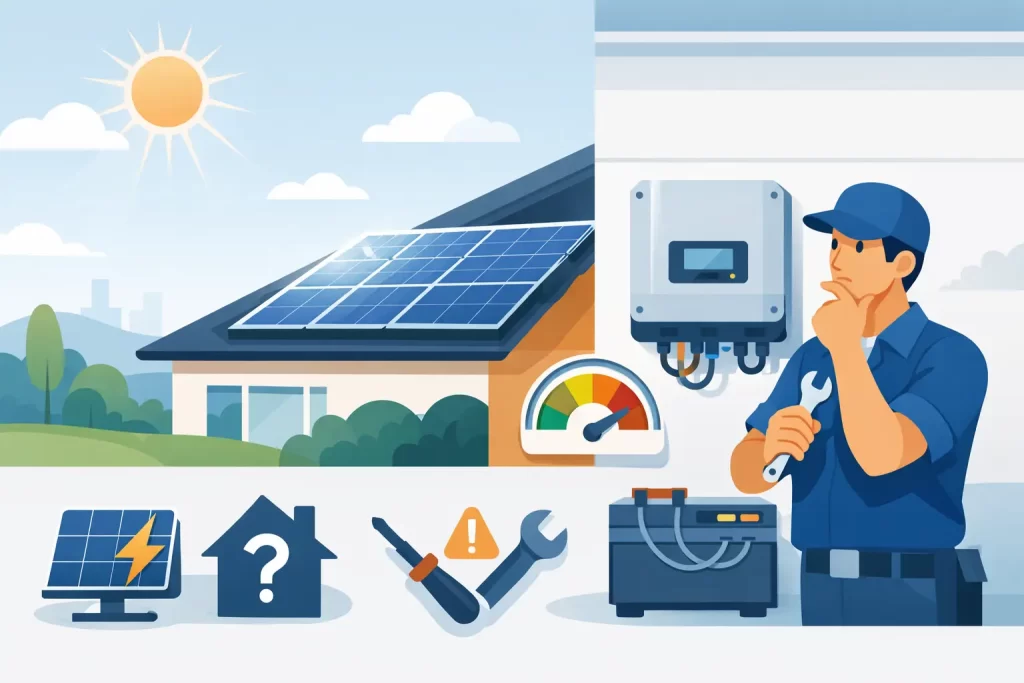
Your panels may still look spotless on the roof while the part that converts their power has stopped doing its job. Knowing when to replace solar inverter equipment is one of the most valuable decisions a solar owner can make. Leave a failing inverter too long and your system can quietly lose generation, reducing the savings you expected from your investment.
An inverter is not a fit-and-forget box. It works hard every day, managing high-voltage DC electricity from the panels and turning it into usable AC electricity for your home. Heat, weather, electrical faults and age all take their toll. The right replacement can restore performance and prepare the system for a battery or other upgrade. The wrong one can create compliance problems, limit output and leave you with another expensive fault.
How long should a solar inverter last?
Most residential solar inverters last around 10 to 15 years, although this varies widely. A quality unit in a cool, well-ventilated location may last longer. An inverter installed in a hot loft, exposed outbuilding or cramped cupboard may age more quickly. Older systems can also have components that are no longer supported or available.
Age alone does not prove that the inverter has failed. A system that is producing normally and has no recorded errors does not need replacing simply because it has reached a certain birthday. But once an inverter is beyond its original warranty period, a professional health check is sensible, particularly before winter or before adding battery storage.
A replacement is often more cost-effective than a major repair on an obsolete unit. This is especially true where replacement boards are difficult to source, the warranty has expired, or the repair offers no certainty that another component will not fail soon afterwards.
Signs you may need to replace a solar inverter
The clearest warning is a fault code on the display or monitoring app. However, not every inverter fault means the inverter itself is at fault. Grid voltage issues, damaged cabling, failed DC isolators, poor connections, shading changes and panel string faults can all trigger similar messages. Diagnosis must come before replacement.
Common warning signs include:
- A red warning light, repeated error code or inverter display that will not power up.
- Generation that has dropped sharply compared with the same period in previous years, after allowing for weather and seasonal variation.
- Regular shutdowns during sunny periods, often shown as grid or voltage-related faults.
- Unusual noise, burning smells, heat damage, water ingress or visibly degraded switches and cabling.
Do not ignore physical warning signs. An inverter that smells hot, trips electrical protection, has a damaged enclosure or shows signs of water ingress needs prompt professional attention. Do not remove covers or attempt to reset isolators repeatedly. Solar PV systems contain live DC circuits whenever daylight reaches the panels, and DC faults can be dangerous.
Why generation data matters before replacement
A good installer does not turn up, see a fault message and immediately quote for a new inverter. First, they establish what the system should be producing and what it is actually doing. That means reviewing monitoring data, inspecting the inverter, checking AC and DC connections, testing string voltages where appropriate and looking for roof-level causes such as damaged cables, contamination or bird activity.
This matters because a replacement inverter will not cure a poor-performing array. Heavy moss, nesting pigeons, cracked panels, failed optimisers or a badly designed original installation can all reduce output. Replacing a healthy inverter in that situation wastes money and leaves the real problem untouched.
It also protects against a common mistake: assuming a blank monitoring app means there is no generation. Sometimes the internet connection, monitoring dongle or app account has failed while the inverter is still working. The electrical system must be tested, not judged solely through an app.
Choosing the right replacement inverter
When it is time to replace solar inverter equipment, choosing the model is not as simple as matching the old unit’s kilowatt rating. The replacement must suit the array’s DC size, string configuration, panel orientation and local electrical supply. It must also be compatible with any planned battery, EV charger, export limitation or future panel upgrade.
Do not simply fit a bigger inverter
A larger inverter is not automatically better. If the panels cannot provide enough DC power to use its capacity, you pay more without a meaningful gain. Conversely, a unit that is too small can cap output unnecessarily on bright days. Some carefully calculated DC oversizing is normal and can improve annual yield, but it must be designed around the panels, inverter limits and manufacturer rules.
Older systems are particularly varied. You may have one string, two roof aspects, separate arrays, microinverters, power optimisers or an inverter with a now-discontinued monitoring platform. The best replacement depends on what is already on the roof, not just what is advertised as the latest model.
Think ahead to battery storage
If you are considering a battery in the next few years, inverter replacement is the ideal time to plan properly. A hybrid inverter may allow a DC-coupled battery installation, but it is not always the best answer. An AC-coupled battery can be a sensible option for an existing PV system, especially where the current array and inverter arrangement do not suit a hybrid design.
The choice depends on your household demand, export tariff, available space, budget and whether backup power is required. Backup is not automatic. Many battery systems switch off during a power cut unless they have been specifically designed and installed with an approved backup arrangement.
Compliance is part of the job, not an optional extra
Replacing an inverter changes a generating system connected to the public electricity network. The work must be completed safely, tested correctly and notified or approved through the relevant process with the distribution network operator. Whether G98 notification is suitable or prior G99 approval is needed depends on the system and proposed equipment.
A competent installer will also check earthing, circuit protection, isolation, labelling and cable condition. These details are not paperwork for paperwork’s sake. Poor isolation, undersized cables, unsuitable enclosures and inadequate labels are common findings on poorly installed systems, and each can create a safety or maintenance problem later.
If you receive Feed-in Tariff payments, keep records of the replacement, commissioning and generation metering arrangements. Inverter replacement does not necessarily end those payments, but changes should be documented correctly so there is no avoidable confusion over meter readings or system capacity.
What a professional inverter replacement should include
The replacement itself is only one stage of the work. The system should be safely shut down, inspected and tested before the old unit is removed. The new inverter must be installed in a suitable location with appropriate clearances and protection from excessive heat or moisture.
After installation, the engineer should commission the unit, confirm correct generation, configure monitoring and check that the system is operating as intended. You should receive clear handover information, including the new inverter warranty, monitoring access, test results and any notification paperwork that applies.
Be cautious of quotes that offer an inverter swap with no site inspection, no electrical testing and no discussion of compatibility. A cheap replacement can become costly if it leaves behind damaged connectors, failed isolators or a fault on the panel strings. The workmanship around the inverter is as important as the box on the wall.
Protect the new inverter from repeat problems
A new inverter cannot prevent every fault, but it should not be left to work in poor conditions. Keep its ventilation clear and avoid storing boxes, coats or household items around it. If it is in a loft, check that summer heat is not excessive. If it is in a garage or outbuilding, make sure the enclosure and cable entries remain dry and secure.
Monitoring is equally useful. Check generation periodically against the same month in previous years, rather than expecting identical output day to day. A gradual fall may point to dirty panels, shade from growing trees or contamination from birds. A sudden drop deserves investigation before small defects become a full system shutdown.
For homeowners dealing with an ageing, faulty or poorly installed system, Safer Solar UK approaches inverter work as a full system check rather than a quick box swap. That is how performance, safety and the condition of the roof installation stay connected.
A solar inverter replacement is a chance to put right more than an error code. Ask for a proper diagnosis, choose equipment that suits how you use energy now and where you are heading next, and insist on work that protects the whole system rather than merely getting the display back on.