
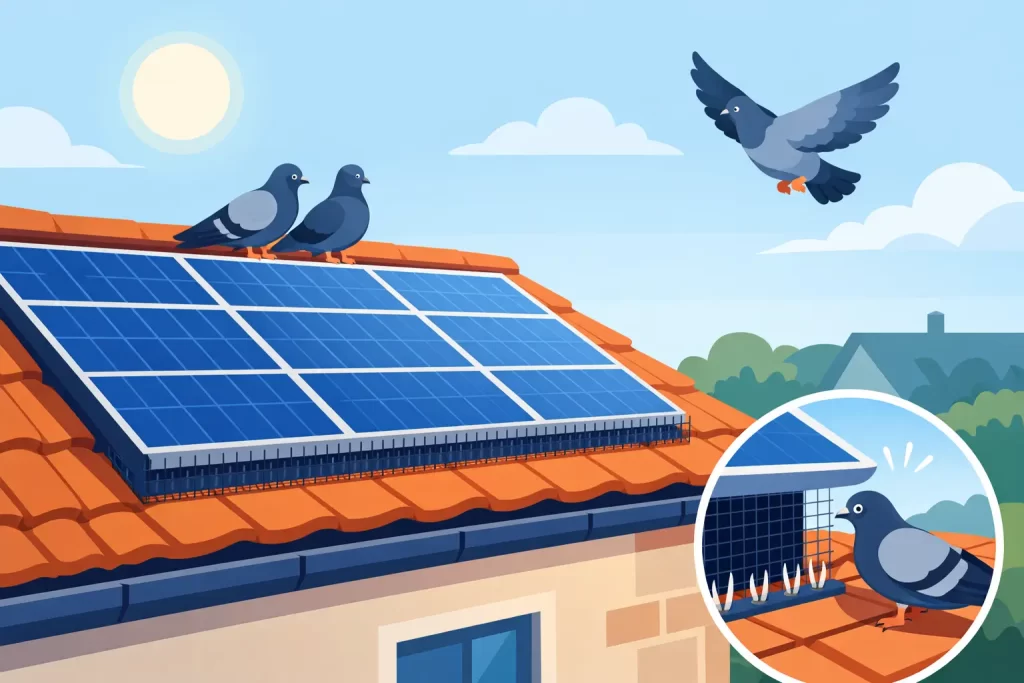
A few pigeons on the roof can quickly become a costly solar problem. Once birds find the sheltered gap beneath a solar array, they return to nest, bring in debris and leave droppings where they are hardest to remove. Solar pigeon proofing closes off that access without interfering with the panels, their ventilation or the roof beneath.
This is not a cosmetic add-on. A properly fitted bird-proofing system protects the working parts of a solar installation, keeps the roof area more hygienic and makes future maintenance far more straightforward. The key word is properly. Cheap mesh, loose fixings and work completed without understanding solar systems can create a second problem while trying to solve the first.
Why pigeons beneath solar panels are a serious issue
Solar panels create a warm, dry, covered space that pigeons find ideal for nesting. The underside of an array is protected from wind and rain, while the panels offer a convenient ledge for birds landing on the roof. Once nesting material starts to build up, the issue rarely stays contained to one corner.
Droppings are acidic and unhygienic. They can spread across panel edges, gutters, roof tiles and the ground below, while feathers, twigs and nesting debris collect in places that are difficult to inspect from ground level. Blocked gutters can lead to overflowing water, staining and damp-related problems around the property. In severe cases, debris beneath the array can interfere with drainage paths and increase the maintenance burden on the roof.
There is also a performance consideration. Heavy soiling on the visible face of panels can reduce the light reaching the cells. Bird activity does not always cause an immediate, dramatic fall in generation, but it can contribute to persistent contamination that needs professional cleaning. More importantly, a nest-filled void makes it harder to check cables, connectors and mounting components safely.
Pigeons may peck at or dislodge exposed cable clips, and persistent activity can put parts of a poorly installed system under unnecessary strain. The panels themselves are durable, but solar PV is not a surface that should be treated like an ordinary roof. Any work around the array needs to protect electrical connections, panel frames, roof coverings and the mounting system.
What professional solar pigeon proofing should involve
Effective solar pigeon proofing is a tailored installation, not a roll of mesh pushed under the panels. Every roof has a different panel layout, tile profile, roof pitch and access requirement. The correct approach starts with a close inspection of the array and the surrounding roof area.
Inspection before fitting
Before mesh is installed, a specialist should identify where birds are entering and whether there is an existing nest, accumulated debris, damaged tiles or signs of previous poor workmanship. This is also the time to check for loose cable management, panel gaps that need particular attention and areas where guttering may already be affected.
Active bird nests must be handled responsibly. Wild birds and their nests have legal protection while a nest is in use or being built, so work may need to be scheduled around nesting activity. A professional will not simply tear out an active nest to finish the job quickly. That approach is irresponsible and can create legal issues as well as further disturbance on the roof.
Mesh that fits the solar system, not just the gap
The usual solution is a durable coated mesh fitted around the perimeter of the solar array using purpose-made clips. Where suitable, these clips attach to the panel frame rather than requiring holes to be drilled through the panels or roof. The mesh must be strong enough to stop birds entering, yet fitted carefully so it does not bridge ventilation spaces or sit loose against the roof.
Cut edges and corners matter. A rushed installation often leaves gaps large enough for pigeons to force their way through, sharp sections that could catch debris, or mesh that is visibly bowed and likely to fail. Neat fitting is not just about appearance. It helps the barrier remain secure through wind, rain and seasonal temperature changes.
The materials should also be appropriate for the outside environment. Lightweight plastic netting and improvised wire may look cheaper at first, but they can become brittle, sag or detach. When that happens, birds can return and the property owner is left paying for removal and replacement work.
Cleaning the affected area safely
Where accessible and appropriate, existing nesting debris and droppings should be dealt with as part of the remedial work. This is not a job for a high-pressure washer pointed at the underside of the panels. Aggressive cleaning can drive water into vulnerable areas, disturb roof tiles or damage components.
The right cleaning method depends on the condition of the panels, the roof covering and how extensive the contamination is. The objective is to remove the source of the problem safely, not to make the roof look clean for a week while leaving trapped debris underneath.
Signs your home needs solar pigeon proofing
You do not need to wait until a nest is visible. Repeated cooing from the roof, birds regularly disappearing beneath the array, feathers collecting in the gutters or droppings concentrated below the panels are all warning signs. A smell from the loft space or an unusual build-up of flies can also point to nesting material in a concealed area.
Look at the roof from a safe distance. If pigeons are consistently landing on the same panel edge or walking under the array, assume they have identified a route in. Do not climb onto the roof or lift panels to investigate. Aside from the fall risk, disturbing the solar mounting system without the correct knowledge can damage tiles, compromise weatherproofing or affect warranties.
It is particularly sensible to arrange an inspection after a new solar installation if the panels have been fitted close to established pigeon roosting areas. Homes near town centres, railway lines, industrial buildings, food premises and busy high streets can be more exposed, but any property can be affected. It depends on the local bird population and the design of the array, not simply the postcode.
Why DIY mesh often creates more expense
Homeowners understandably see bird mesh as a simple barrier, but the difficult part is access and correct fitting. Solar panels sit on a roof, often several metres above ground, with live electrical equipment nearby. Reaching the array safely requires the right access equipment, safe working practices and an understanding of where not to stand, pull or apply pressure.
A common mistake is attaching mesh directly to tiles, using adhesives that fail in weather or fixing to the panel frame in a way that scratches it. Another is blocking air flow beneath the panels. Solar modules need ventilation to manage heat, so proofing must close bird entry points without boxing the system in.
There is also the issue of hidden faults. If a bird-proofing installer does not understand solar PV, they may miss a loose cable, a damaged clip, a cracked tile or an inverter-related generation issue that needs separate attention. Conversely, a solar specialist can identify when pigeon activity is only one part of a wider maintenance problem.
Safer Solar UK approaches this work as solar system protection, not generic pest control. That means considering the panels, mounting hardware, roof condition, cabling and future access together before a solution is fitted.
Protect the roof as well as the generation
Pigeon proofing works best as part of planned solar aftercare. Once the mesh is in place, occasional visual checks can confirm it remains secure and that birds have not found access elsewhere. If panels become soiled, arrange cleaning methods designed for solar equipment rather than treating them as ordinary glazing.
It is also worth keeping an eye on generation through the inverter or monitoring app. A gradual drop may be seasonal, caused by shading or linked to dirt, but a sudden change deserves investigation. Bird activity, contamination and electrical faults are different issues, and guessing can lead to unnecessary work or a missed fault.
The best time to act is when pigeons first start treating the underside of the array as shelter, not after months of nesting, blocked gutters and contamination. A carefully installed barrier keeps the space beneath the panels where it belongs: protected, ventilated and free from unwanted tenants.