
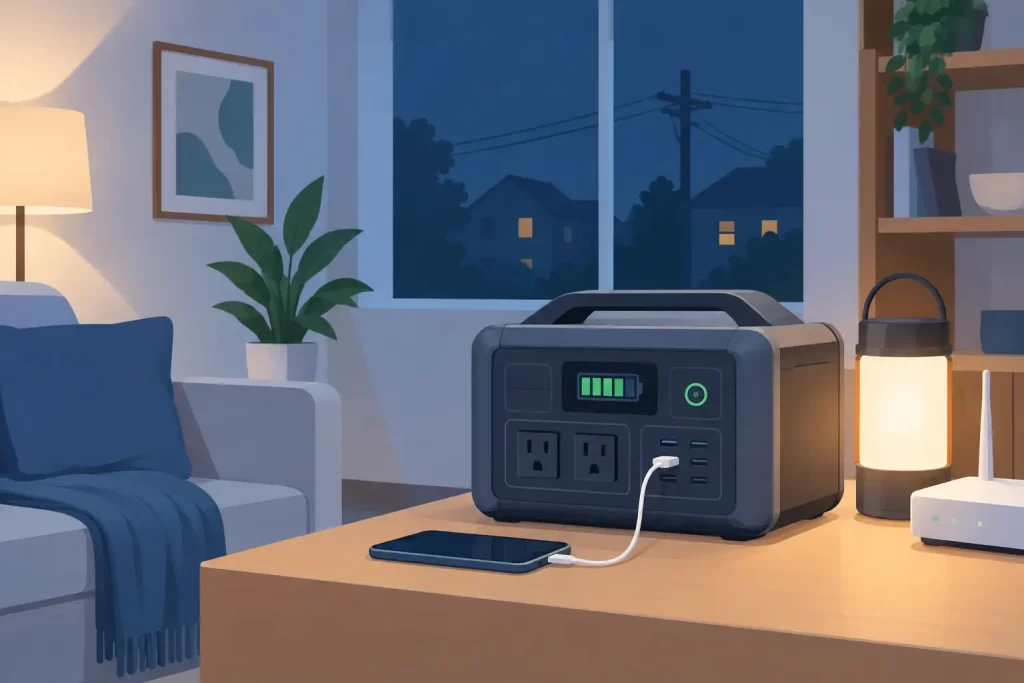
When the street goes dark, a normal solar and battery system may go dark with it. That catches many homeowners out. Battery backup for outages is not simply a battery added to an existing PV array: it is a correctly designed backup arrangement that can safely separate your property from the grid, keep selected circuits live and manage solar generation while the network is down.
For households relying on electric heating controls, broadband, refrigeration, medical equipment or a home office, that distinction matters. A battery that only shifts cheap overnight electricity is useful, but it is not automatically an emergency power supply.
Why most solar batteries do not work in a power cut
Grid-connected solar inverters are designed to shut down when the mains supply fails. This is an essential safety measure, not a fault. If an inverter continued exporting electricity onto a damaged local network, it could put engineers working on the cables at risk.
The same principle applies to many battery installations. They may be fully charged, healthy and working perfectly one minute, then stop supplying the house when the grid drops. Without a specified backup output, changeover equipment and suitable electrical design, the battery cannot legally or safely power your home during an outage.
A genuine backup system uses an emergency power supply, often called EPS, or a dedicated backup gateway. It detects the loss of grid supply, isolates the property from the network and creates a controlled local supply from the battery. The changeover can take a few seconds, depending on the equipment. Lights may flicker and some devices may reboot, so it should not be treated as an uninterruptible power supply for sensitive equipment unless that is specifically designed into the installation.
Battery backup for outages starts with the circuits
The best question is not, “How big a battery do I need?” It is, “What must keep working?” Trying to power every circuit in a modern house can make a backup project needlessly expensive and can create a disappointing result when high-demand appliances drain the battery quickly.
Most homes are better served by an essential-loads consumer unit. This is a separate board containing the circuits that genuinely matter during a cut, such as the fridge-freezer, kitchen sockets, broadband router, selected lighting, boiler controls and perhaps a home-office socket. The battery then has a clear, manageable job.
A whole-home backup arrangement can be appropriate for larger batteries and households with carefully managed demand. However, it needs proper assessment. An electric shower, induction hob, immersion heater, tumble dryer, heat pump or vehicle charger can overwhelm a backup inverter or flatten a battery far faster than expected. A 10 kWh battery may sound substantial, but a sustained 5 kW load could use its usable energy in around two hours before allowing for operating limits and losses.
Power and capacity are different figures
Capacity, measured in kilowatt-hours (kWh), tells you how much energy the battery can store. Power, measured in kilowatts (kW), tells you how much it can deliver at one time. Both must be right.
A battery with ample storage but a 3 kW backup output may run lights, refrigeration and sockets comfortably, yet struggle if someone starts the kettle while the microwave is on. Motor-driven appliances can also demand a brief surge as they start. The inverter, battery and backup board must be specified for the expected continuous load and those short peaks.
This is why a cheap battery quote based on capacity alone is not enough. A proper design checks the backup output rating, usable capacity, appliance starting loads, cable routes, protective devices and whether the chosen circuits can be safely separated from non-backed-up loads.
How long will a home battery last during an outage?
Runtime depends on consumption, not just the battery label. A carefully managed essential-loads setup averaging 300 watts could make 10 kWh of usable storage last well over a day. Add a kettle, cooking appliances and electric heating, and that same battery can be depleted in a fraction of the time.
During a prolonged outage, behaviour makes the difference. Keep fridge and freezer doors closed, use the kettle deliberately rather than repeatedly, avoid resistive heaters and postpone washing or drying. Broadband equipment, LED lighting, a modern fridge-freezer and phone charging use relatively modest energy. Heating water with an immersion heater does not.
Solar can extend runtime, but it is not a guarantee. In bright conditions, a suitably configured system can recharge the battery and support daytime loads while islanded from the grid. In a British winter, output may be limited by short days, cloud, shading, dirt or snow. If panels are heavily contaminated or an inverter is already underperforming, an outage is a poor time to discover it.
Can an existing solar system be upgraded for backup?
Often, yes, but the route depends on the equipment already in place. An AC-coupled battery can be a practical option where an existing solar inverter is retained. In other cases, replacing an ageing inverter with a hybrid unit provides a cleaner long-term arrangement for solar, battery charging and backup control.
Compatibility has to be checked rather than assumed. Some older PV inverters cannot operate correctly alongside every battery during off-grid operation. The battery may need to control solar output to avoid overcharging once household demand falls. Equipment settings, export limitation arrangements and communications between devices all matter.
The physical installation matters too. Backup work can involve alterations to the consumer unit, new protective devices, dedicated cabling, isolation points and a revised circuit layout. It should not be treated as a plug-in accessory. Work around solar generation and mains supplies carries real shock, fire and backfeed risks when carried out badly.
A specialist survey should also identify faults before expanding the system. There is little value in adding storage to panels affected by failed optimisers, inverter errors, bird damage, poor cable routing or shading from unchecked roof contamination. Safer Solar UK approaches upgrades as part of the complete system, because a battery can only perform as well as the solar and electrical installation feeding it.
What a proper backup survey should establish
Before selecting equipment, an installer should establish what your current system produces, how and when your household uses electricity, and which circuits are essential. They should inspect the existing inverter, consumer unit, earthing arrangement, cable condition and available installation space.
They should also discuss the type of outages you are planning for. A few short interruptions each year call for a different budget and design from rural properties that experience extended cuts. If resilience is the priority, keeping a larger reserve of battery capacity may be preferable to using every stored unit overnight on a time-of-use tariff. That reserve reduces bill-saving flexibility, but it means there is meaningful energy available when the grid fails.
Permissions and notifications must be dealt with properly. Any generation and storage work connected to the distribution network has technical requirements, and larger or more complex changes may require approval before installation. A professional installer will make sure the work is designed, tested, labelled and documented correctly, rather than leaving you with a system that is difficult to maintain or unsafe to alter later.
Avoid these common backup mistakes
The first mistake is assuming every battery provides backup. Ask specifically whether the proposed system supplies power during a grid outage, which circuits it supplies, how much backup power it delivers and whether solar will operate at the same time.
The second is sizing around an optimistic daily average. Outages often happen in poor weather, when solar production is low and household demand may be higher. Plan around essential loads and realistic winter conditions, not a sunny-day generation graph.
The third is backing up heavy loads without a control strategy. Whole-house capability may be worthwhile, but only where inverter power, storage capacity and load management support it. A system that trips every time an appliance starts is not dependable backup.
Finally, do not overlook maintenance. Battery software, inverter alerts, isolators, cable entries and consumer-unit labelling should be checked as part of ongoing system care. If pigeons have nested beneath panels or water has reached rooftop cabling, deal with those issues properly before relying on the system in an emergency.
A well-designed battery backup arrangement gives you more than stored electricity. It gives you a sensible plan for the moments when the grid cannot be relied on: essential circuits protected, solar used safely where conditions allow, and no unpleasant surprises when you need power most.