
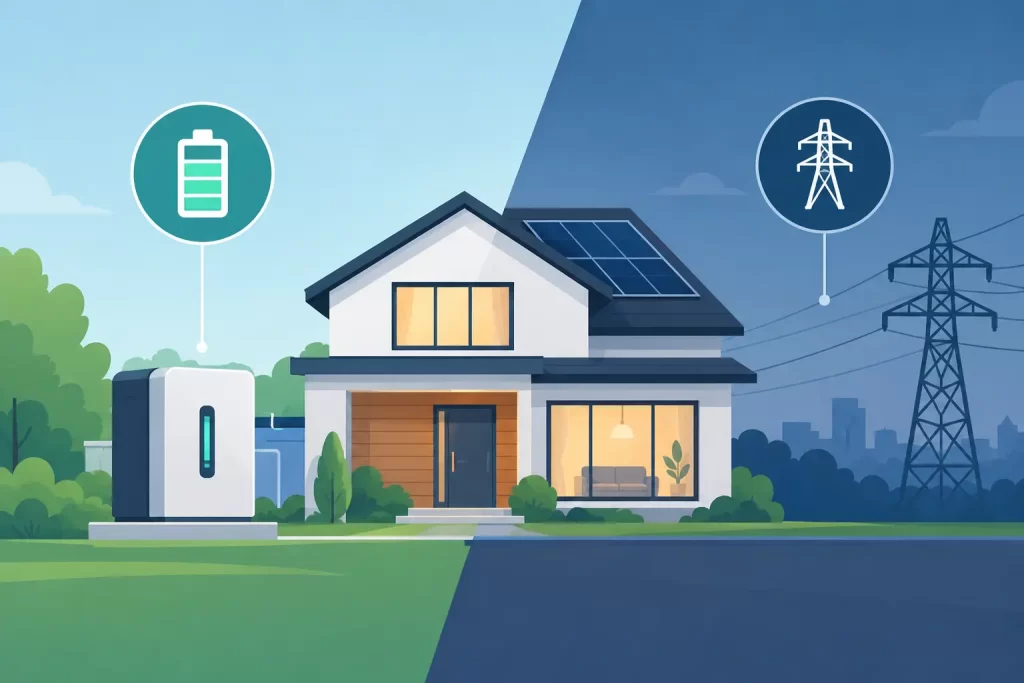
A home with solar panels can still go dark when the street loses power. That surprises many homeowners comparing battery backup versus grid supply. Solar generation, battery storage and backup power are connected, but they are not the same thing. The difference comes down to how your system is designed, what it is allowed to do during an outage, and what you need it to protect.
For most UK homes, the grid remains the main safety net. A battery can reduce imports, hold cheaper electricity for later and make better use of solar generation. A properly specified backup arrangement can also keep selected circuits running when the grid fails. The right answer is not simply “battery or grid”. It is deciding how much independence is worth paying for and ensuring the equipment is installed safely.
Battery Backup Versus Grid: The Real Difference
Grid power is electricity supplied through your local network. It is available whenever your home needs more power than its solar panels and battery can provide. You pay for each imported unit, with the price depending on your tariff. On a standard solar installation without a battery, surplus generation is normally exported rather than stored for the evening.
A home battery stores electricity for later use. It may charge from excess solar, from the grid during lower-priced tariff periods, or from both. It then discharges when household demand is higher, helping to reduce peak-rate imports. This is where a battery can make a meaningful difference to day-to-day bills, especially in homes that generate heavily at midday but use most electricity in the morning and evening.
Battery backup is a separate capability. It means the system can isolate your home from the grid during a power cut and provide power to agreed circuits from the battery, and sometimes from solar as well. Not every battery installation does this. Many systems shut down completely in an outage, as required, because they have no approved backup equipment or safe islanding arrangement.
That distinction matters. Buying a battery because you expect the whole house to run through a blackout, only to find it cannot power a single socket when the grid fails, is an expensive disappointment.
What the Grid Still Does Well
The grid is not the enemy of a solar and battery system. It provides dependable capacity for high-demand appliances that would drain even a sizeable domestic battery quickly. An electric shower, oven, induction hob, kettle, tumble dryer and heat pump can create substantial demand, particularly when several are used together.
A typical battery is intended to shift energy, not turn an average property into an off-grid house. On a cold, dark winter week, solar production can be modest while household consumption rises. The grid fills that gap without the cost and space required for a far larger battery bank.
It also gives you flexibility. A well-configured battery can charge overnight on a suitable time-of-use tariff and discharge through the higher-priced part of the day. If export rates are attractive, there may be times when exporting surplus solar makes more financial sense than storing every unit. The best settings depend on your tariff, generation profile, household usage and battery capacity.
When a Battery Is Worth Considering
A battery tends to work hardest in homes where solar regularly produces more electricity than can be used at the time. If your panels generate strongly while the property is empty, storage can retain more of that value for the evening.
It can also suit households with predictable electricity use. Evening cooking, washing, charging devices and watching television often coincide with reduced solar output. Storing daytime generation for those hours reduces the amount bought from the grid.
There is another practical reason: tariff management. Homeowners on smart tariffs may use battery storage to charge at lower overnight rates, then avoid importing at more expensive periods. That requires sensible programming and an inverter-battery combination that supports the intended control strategy. It should not be treated as a set-and-forget feature, because tariff rates and household patterns change.
A battery is less compelling where daytime usage already absorbs most solar generation, where the system is small, or where electricity consumption is very low. In those cases, the savings may not justify the installation cost as quickly. Honest system design starts with generation and consumption data, not a generic battery size.
Capacity Is Not the Whole Story
A larger battery holds more energy, but capacity alone does not determine how useful it will be. Output power matters too. A battery may have enough stored energy to last for hours, but insufficient discharge power to support several demanding appliances at once.
For example, a 10 kWh battery describes stored energy. Its maximum output, measured in kW, determines what it can run at any moment. A household that wants to cover normal lighting, broadband, refrigeration and a few sockets during an outage has a very different requirement from one expecting electric heating, cooking and an EV charger to continue as normal.
The inverter is equally important. Older solar systems may need an inverter replacement, a compatible AC-coupled battery, or a more substantial upgrade. Compatibility, cable routes, consumer unit condition, earthing and protective devices must be assessed before anyone promises a simple add-on.
Do You Need Backup Power, or Just Storage?
This is the question that prevents most confusion. If your priority is lower electricity bills and better use of solar, standard battery storage may be enough. If power cuts would cause genuine disruption – perhaps because you work from home, rely on medical equipment, have vulnerable occupants, or want refrigeration and communications protected – backup functionality deserves closer attention.
A backup system is normally designed around either essential circuits or whole-home backup. Essential-circuit backup supplies a separate, selected group such as lighting, the fridge-freezer, internet equipment and chosen sockets. It is often the more controlled and cost-effective option because it prevents heavy loads from flattening the battery unnecessarily.
Whole-home backup can be possible, but it needs careful load assessment and appropriately rated equipment. It does not make every appliance sensible to use during a cut. The system may need to manage loads automatically, and household members need clear instructions. Switching on an electric shower or charging an electric vehicle while running on backup can exhaust stored power very quickly.
During an outage, safety comes first. Your property must be electrically isolated from the public network before backup power is supplied. This prevents electricity feeding back onto lines being worked on by network engineers. Proper changeover equipment and compliant installation are not optional extras.
Solar During a Power Cut: Do Not Make Assumptions
Many homeowners assume sunny weather means their panels will continue charging the battery in a blackout. That can be true with the right equipment, but it is not automatic. Standard grid-tied solar inverters shut down when the grid fails. This is an anti-islanding safety measure, not a fault.
A battery system with a suitable backup gateway or dedicated backup connection can form a local supply after isolation. Depending on the make, model and configuration, solar may then continue to operate and recharge the battery while supporting the backed-up loads. Output can still be limited by available sunlight, inverter rating and battery conditions.
This is why specifications matter more than sales language. Ask exactly what happens when the grid fails: which circuits stay live, whether solar can continue generating, how switching occurs, what the maximum backup output is, and whether there are restrictions on high-load appliances.
Costs, Lifespan and Installation Quality
Battery storage is a long-term equipment decision, not a cheap accessory. Costs vary according to capacity, output, battery chemistry, inverter compatibility, backup hardware, consumer unit alterations and the complexity of the installation. A low headline price may exclude the very work that makes the system safe, reliable and useful.
A battery also has a finite usable lifespan. Manufacturers commonly provide a warranty based on years, throughput, retained capacity or a combination of these conditions. The detail matters. A battery used heavily for tariff trading may cycle more often than one used mainly to store surplus solar. Neither approach is automatically wrong, but it should be factored into the expected return.
Poor installation can undermine every claimed benefit. Untidy cabling, unsuitable positioning, inadequate ventilation, questionable protective devices or rushed integration with an existing inverter can create faults and future expense. A specialist should assess the full solar system rather than treating the battery as a box on the wall.
For existing solar owners, this is particularly important. Underperforming panels, inverter faults, bird damage, shading, dirty modules or a poorly configured system should be addressed before calculating battery savings. There is little value in installing storage around a generation problem that has never been properly diagnosed.
Choosing the Right Set-Up for Your Home
Start with your actual half-hourly electricity data if available, along with solar generation figures. Look at how much power you import after sunset, how much solar you export, your highest-demand appliances and the tariffs you can access. Then decide whether your main objective is bill reduction, resilience during outages, improved solar self-consumption, or a combination of all three.
A good installer should be comfortable saying that a smaller battery, an essential-load backup circuit, or no battery at all may be the right choice. They should also explain the limits plainly, rather than implying that battery storage eliminates grid dependence.
If your solar system needs an upgrade or its performance is in doubt, have it inspected before committing to storage. A carefully designed battery can be an excellent addition to a healthy solar system. A correctly specified backup supply can offer real reassurance when the lights go out. The useful next step is to match the system to the loads you genuinely need protected, not the marketing promise you were sold.