
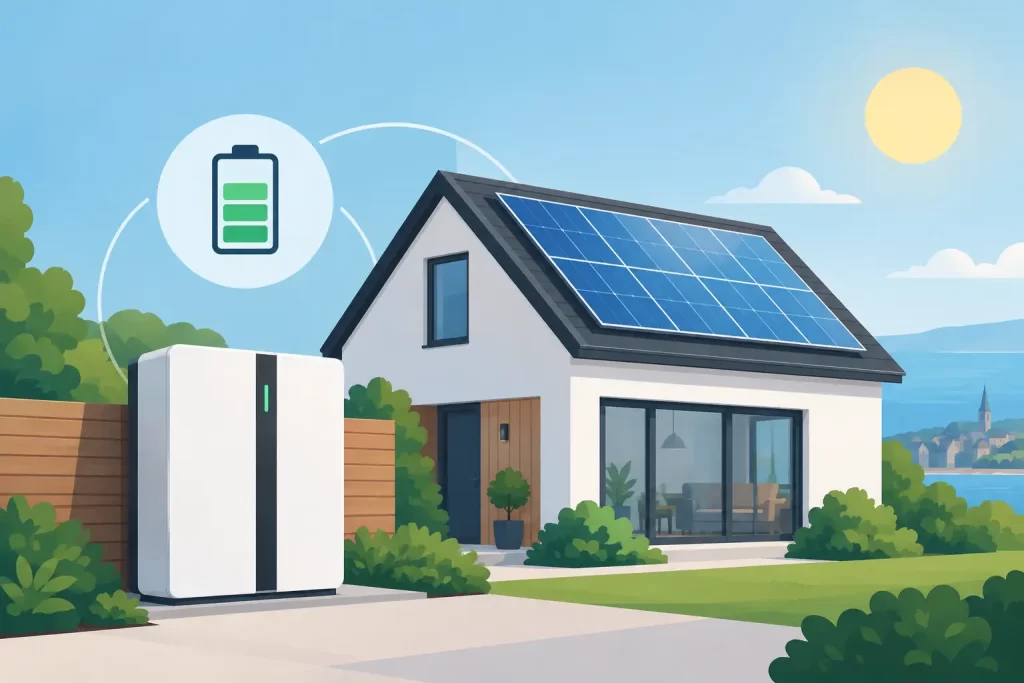
A battery that is too small can be full before lunch and empty before the evening meal. One that is too large may look impressive on a quote but spend much of the year only partly used. This home battery sizing guide explains how to choose capacity around the way your household actually generates and uses electricity, rather than buying on headline figures alone.
For most UK homes, the right answer is not simply the biggest battery the budget allows. It is a balance between solar generation, evening demand, tariff opportunities, backup expectations and the limits of the existing inverter and electrical installation.
Start with the electricity you want to shift
Battery capacity is measured in kilowatt-hours (kWh). This is the amount of electricity it can store. It is different from battery power, measured in kilowatts (kW), which determines how quickly the battery can charge or supply appliances.
The first question is simple: how much electricity do you typically use after your solar production falls away? For many households, the key period is from late afternoon through to bedtime. That is when cooking, washing, televisions, lighting and home working can coincide, while solar output reduces sharply.
Look at your smart meter, electricity app or inverter monitoring over several weeks. Do not base a decision on one unusually sunny day or a winter cold snap. You are looking for a normal pattern: daytime solar generation, daytime household consumption, exported energy and grid imports in the evening.
A household using 8 kWh after sunset does not automatically need an 8 kWh battery. Some energy may still be imported at times of high demand, and some households benefit more from a modest battery that cycles regularly than a large unit that rarely reaches useful capacity. Equally, a family with an electric vehicle, electric cooking and regular evening use may find a small battery is repeatedly drained too early.
A practical home battery sizing guide
As a starting point, many UK solar households fall into these broad ranges:
- A 3 to 5 kWh battery can suit a smaller household with modest evening consumption and a solar array around 3 to 4 kWp.
- A 5 to 10 kWh battery is often a sensible range for a typical family home with a 4 to 6 kWp solar system and meaningful evening demand.
- A 10 to 15 kWh battery may suit larger households, all-electric appliances, higher overnight use or solar arrays producing enough surplus to charge it regularly.
- More than 15 kWh should be justified by measured demand, a larger solar installation, time-of-use tariff charging, backup requirements or a clear plan for future electrification.
These are not fixed rules. A 4 kWp array on a shaded roof in the North will not produce like a larger, south-facing system with little shading. A home where someone works from home may consume much of its solar generation during the day, reducing the need for a large battery. Another property may export heavily every afternoon, then buy expensive electricity throughout the evening. That is a much stronger case for storage.
Do not confuse usable capacity with the number on the box
Not every kWh stated on a battery specification is available for daily use. Manufacturers protect batteries by reserving a portion at the top or bottom of the charge range. This is usually described as depth of discharge, or usable capacity.
For example, a battery advertised at 10 kWh may provide roughly 9 to 9.5 kWh of usable energy, depending on its settings and specification. There are also round-trip losses during charging and discharging. If you put 10 kWh into storage, you will not get exactly 10 kWh back out.
This does not make battery storage poor value. It means the sizing calculation must be honest. A professional proposal should state the usable capacity, expected battery power, warranty conditions and how the system will operate with your existing solar equipment.
Check battery power as well as capacity
Capacity determines how long the battery lasts. Power determines whether it can keep up when several appliances start at once.
A 10 kWh battery with a 3 kW discharge limit can store a useful amount of energy, but it cannot provide more than 3 kW at any one time. If the oven, kettle and dishwasher are all running, the home may still import electricity from the grid even while the battery contains charge. That is normal, not necessarily a fault.
For a typical home, a battery capable of 3.6 to 5 kW continuous output is often practical. Properties with heat pumps, electric showers, induction hobs or high peak loads may need a more careful design. Trying to make a battery carry an entire house without checking demand can lead to disappointment and unnecessary cost.
Size around your solar system, not just your bill
A battery can be charged from solar, the grid or both, depending on the system and tariff. Yet the amount of solar surplus available remains central to sensible sizing.
During spring and summer, a correctly sized solar array may charge a battery most days. In winter, shorter daylight hours, low sun angles and cloud cover can leave little surplus, particularly where panels face east and west, have shading, or are affected by dirt, moss or bird contamination. A large battery will not create solar energy that the roof has not generated.
Before adding storage to an older system, check that the panels, cabling, inverter and monitoring are performing properly. An underperforming array can make a new battery look ineffective. Fault finding, generation checks and panel condition should come before assuming that more storage is the answer.
Factor in your tariff and charging habits
A battery is not only for storing solar surplus. On a suitable time-of-use tariff, it can charge when electricity is cheaper and supply the home during higher-priced periods. This can improve the value of a larger battery, especially through winter when solar charging is limited.
But tariff charging needs control. The battery should be configured so it does not fill from the grid at the wrong price, export cheap-rate electricity accidentally, or leave no room for expected solar production. Settings should reflect how the household lives, not be left on a generic installer default.
If you are considering an electric vehicle or heat pump in the next few years, mention it before the battery is specified. Future demand can justify an expandable battery system, but it does not always justify buying all the capacity now.
Backup power is a separate design decision
Many homeowners assume a solar battery will keep the house running during a power cut. That is not automatically true. Standard grid-connected systems normally shut down during an outage to protect electricity network workers.
Backup requires suitable equipment, isolation arrangements and a properly designed essential-loads circuit. You may choose to support lighting, the broadband router, fridge, freezer and selected sockets, rather than attempting to run every circuit in the property. The battery size, output rating and backup arrangement must all be considered together.
This is an area where cheap, poorly explained installations cause problems. Backup capability should be specified clearly before work starts, not discovered after an outage.
Assess the existing installation before upgrading
Battery retrofits can work very well, but the existing solar system needs a proper survey. The inverter type, age, solar array size, consumer unit, earthing arrangement, cable routes and available installation space all matter. So do fire safety, ventilation requirements, access for maintenance and manufacturer clearances.
AC-coupled batteries are often suitable for adding storage to an existing solar system without replacing the solar inverter. DC-coupled systems can be highly efficient in the right setup, particularly as part of a new or major upgraded installation. Neither is automatically better. The right approach depends on the equipment already in place and the performance you need.
At Safer Solar UK, the focus should be on a battery system that works safely with the roof, panels and electrical equipment you already own, not on forcing a standard package into every property.
Choose a battery that will be used, protected and supported
A sensible battery should cycle often enough to earn its place, without being stretched beyond its intended use. It should have a clear warranty, realistic usable capacity and an installer who can diagnose settings, communications faults and inverter issues after commissioning.
Start with real generation and consumption data, then build the system around your next few years rather than a sales target. A well-sized battery is not the largest unit on the wall. It is the one that reduces costly imports, makes proper use of your solar generation and continues doing its job safely long after the installation day.