
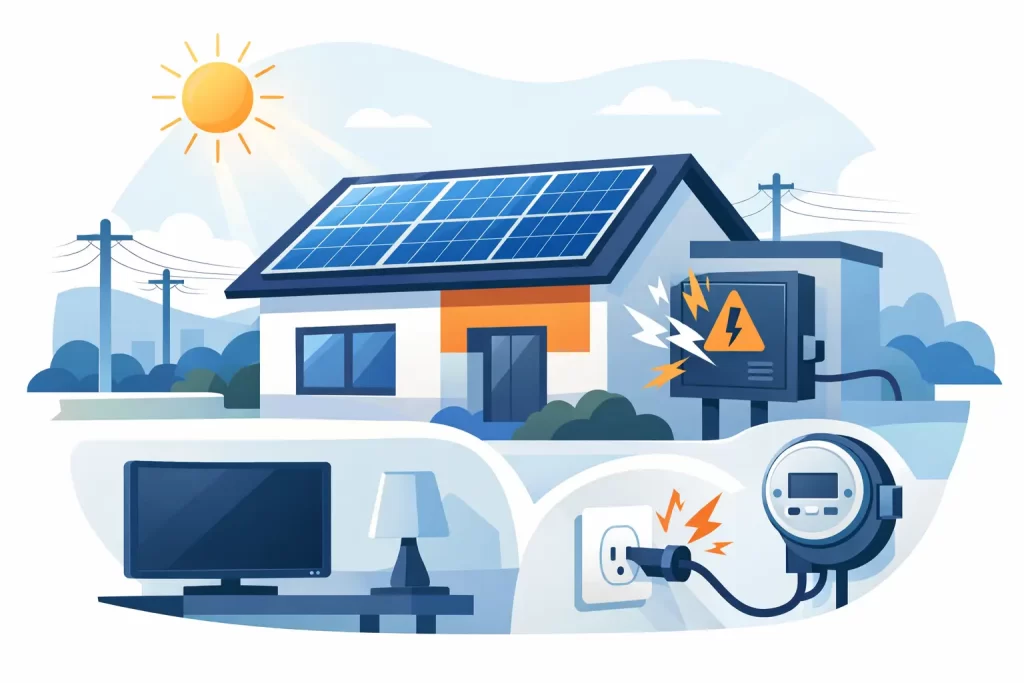
A bright, clear day should be when your solar system earns its keep. If the inverter repeatedly shuts down just as generation peaks, that is exactly when a voltage trip is most likely to show itself. Homeowners asking what causes solar voltage trips are usually dealing with an inverter that is protecting the property, the local network and itself – not necessarily a failed panel or a faulty inverter.
The important point is this: do not treat repeated trips as normal. A system that regularly disconnects can lose valuable generation during the best part of the day. The cause may sit within the installation, in the cable route, or on the electricity network beyond your property. Proper diagnosis matters because the wrong fix can be unsafe, non-compliant and expensive.
What Is a Solar Voltage Trip?
Your inverter converts the direct current produced by the panels into alternating current for use in your home and export to the grid. To do this safely, it constantly checks the grid supply. If it detects voltage outside its permitted operating limits, it must disconnect.
In most cases, a homeowner sees an error such as “grid overvoltage”, “AC voltage high”, “mains fault” or “vac failure”. The inverter may reconnect automatically after a short wait, then trip again if the voltage remains too high.
UK electricity supplies are nominally 230V, but the permitted upper limit is 253V. Solar inverters are configured to work within the requirements of G98 or G99 connection standards. They cannot simply be set to ignore high voltage. Altering protection settings without authority is not a clever workaround – it can breach network requirements and put equipment at risk.
What Causes Solar Voltage Trips Most Often?
High grid voltage is the usual culprit, particularly in areas with lots of solar PV connected to the same local circuit. But the message on the inverter screen is only the starting point. The reason the voltage rises needs to be established.
High voltage from the local electricity network
Voltage on the local network often rises in the middle of a sunny day. Your neighbours may be producing solar power too, while local demand is low. That exported power pushes voltage back towards the transformer, and the voltage at homes further along the line can rise.
This is more common on rural supplies, long overhead runs and streets where solar uptake has been high. It can also be seasonal. A system may work perfectly through winter, then begin tripping frequently on cloudless spring and summer days when output is strongest.
The electricity network operator is responsible for the supply up to the appropriate point of connection, but they need useful evidence before they can investigate. One quick voltage reading taken in the kitchen is rarely enough to prove the case.
Voltage rise in your own solar cabling
Even where the incoming supply is acceptable, voltage can rise between the consumer unit and inverter when the system exports power. This is known as volt rise.
Every cable has resistance. If the AC cable between the inverter and consumer unit is undersized, unnecessarily long, poorly routed or badly terminated, the exported current creates a voltage increase at the inverter. In simple terms, the inverter sees a higher voltage than the supply actually has at the meter and disconnects before it is allowed to export safely.
This is a common issue on rushed or poorly designed installations, especially where an inverter has been fitted in a garage, loft or outbuilding a long way from the consumer unit. It can also appear after an upgrade. A cable suitable for a smaller system may no longer be suitable when extra panels or a higher-capacity inverter are added.
Poor connections or ageing installation work
Loose, corroded or overheated connections can create resistance and unstable voltage readings. The issue may be at the inverter isolator, AC isolator, consumer unit, generation meter or a junction point installed out of sight.
These are not cosmetic faults. Heat at an electrical connection can damage terminals, cable insulation and surrounding equipment. If an inverter is tripping alongside burning smells, discolouration, buzzing, flickering lights or warm isolator switches, switch the system off if it is safe to do so and arrange an urgent professional inspection. Do not repeatedly reset it and hope for the best.
A battery, EV charger or solar upgrade changing the picture
Home energy systems interact. A battery may reduce exports when it is charging, but once full it may allow solar export to rise sharply. An EV charger, heat pump or other heavy load can alter the voltage profile on a phase, particularly in properties with three-phase supplies.
An extension to an older solar array can cause trouble too. More generation is not automatically better if the original cable sizing, protection, inverter capacity and network notification have not been reviewed. The installation needs to be assessed as one electrical system, not as a collection of separate add-ons.
Inverter settings, firmware or equipment faults
An inverter fault is possible, but it should not be the first assumption. A competent engineer will first compare inverter readings with measured supply voltage and check whether the fault occurs at predictable export levels.
Incorrect regional settings, unsuitable grid-code parameters or outdated firmware can cause unnecessary disconnections. So can a failing internal voltage-sensing circuit. However, replacing an inverter before checking the supply and cable volt rise can leave you with a new inverter that trips in exactly the same way.
DC Voltage Trips Are a Different Fault
Not every “voltage” warning relates to the grid side of the system. A DC overvoltage fault normally concerns the panel strings feeding the inverter. It can be caused by too many modules in a string, an incorrect design calculation, replacement panels with different electrical characteristics, or exceptionally low temperatures pushing string voltage above the inverter’s limit.
A DC issue requires a different investigation from an AC grid overvoltage trip. The wording and fault code matter. Take a clear photograph of the inverter display before restarting anything, as the code gives the engineer a valuable first direction.
Why Repeated Resetting Is Not a Fix
Most inverters will attempt to reconnect automatically once voltage returns to an acceptable level. If yours does, leave that protective function to do its job. Manual resets may clear the displayed fault temporarily, but they do not remove the underlying voltage problem.
More importantly, do not adjust installer-level grid settings, change breaker sizes or bypass isolators. These protections exist for a reason. Electrical work around solar PV involves live AC and DC circuits, and panels continue generating whenever there is daylight.
How a Proper Solar Voltage Trip Investigation Works
A proper investigation starts with evidence rather than guesswork. An engineer should review the inverter fault history, time of day, generation levels and the system’s installation details. The pattern is often revealing: trips only at midday on sunny days point in a very different direction from random faults during low generation.
They should then measure voltage at relevant points, including the supply position and inverter connection, while the system is operating where possible. Comparing those readings shows whether the excess voltage is arriving from the grid or developing along the installation cable.
The physical installation also needs attention. Cable size and route, isolator condition, protective devices, earth arrangements, consumer-unit connections and signs of heat damage all need checking. For upgraded systems, the original design and network paperwork should be reviewed as well.
Where a supply issue is suspected, a voltage logger may be fitted to record readings over several days. This produces the evidence needed for the Distribution Network Operator to assess the local supply. Depending on the findings, the DNO may investigate its transformer settings, network balance or capacity. Their solution is not guaranteed, and timescales vary, but a documented fault is far stronger than a report that the solar inverter “keeps going off”.
The Right Remedy Depends on the Cause
If cable volt rise is the issue, the remedy may involve improving the AC cable route, installing correctly sized cable or correcting defective terminations. If the network supply is high, the DNO needs to be involved. In some circumstances, export limitation or battery control can reduce peak export and stop trips, but this is a performance trade-off rather than a universal cure.
A battery that absorbs surplus generation can be useful where it suits the household’s energy use, but it should not be sold as a substitute for correcting unsafe cabling or poor workmanship. Likewise, voltage optimisation equipment is not a blanket answer for inverter overvoltage faults. Its suitability depends on where the high voltage is occurring and how the solar system is connected.
Repeated solar voltage trips are a warning that your system is being prevented from generating as designed. Getting the readings, cable calculations and protection settings checked by a qualified solar specialist protects both your income from the system and the safety of the home it serves.