
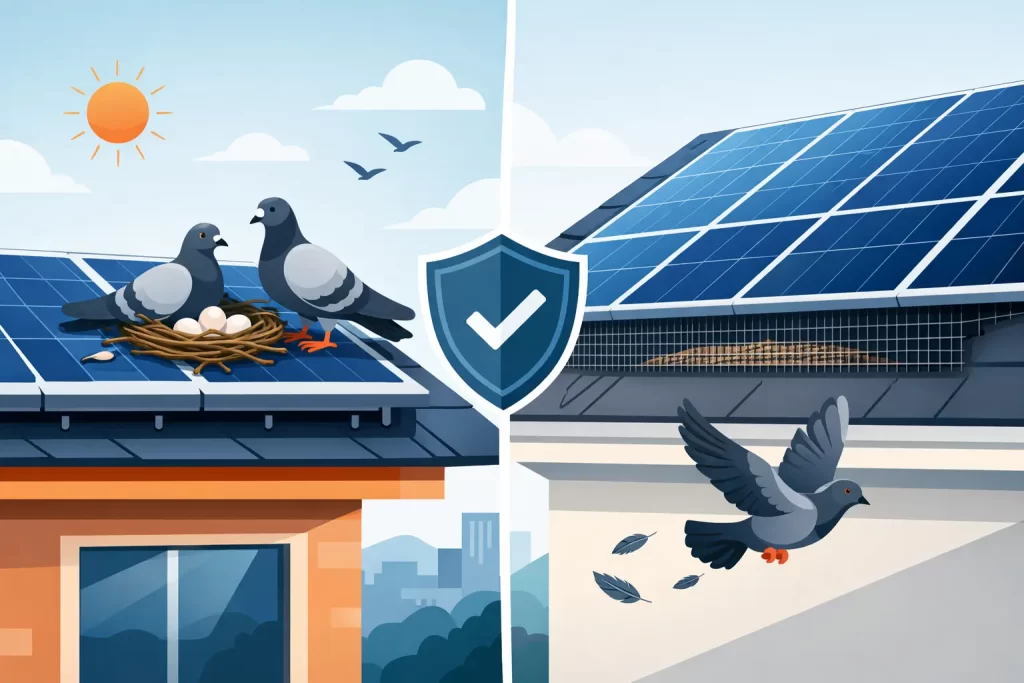
A few pigeons landing on a roof can quickly become a much bigger problem once they find the sheltered gap beneath a solar array. To prevent pigeon nesting properly, homeowners need more than a quick clean or a strip of loose mesh. The work must remove existing debris, protect the full panel perimeter and avoid damaging the roof, panels, frames or electrical cabling.
Pigeons are drawn to solar panels because the space beneath them is dry, warm and protected from wind and predators. Once nesting begins, the problem usually escalates. Droppings build up on panels and roof tiles, nesting material blocks drainage routes, and birds return to the same spot year after year.
Why pigeon nesting under solar panels is a serious issue
Pigeon activity is often treated as a cosmetic nuisance. It is not. Heavy fouling can reduce the amount of daylight reaching the panels, particularly where droppings sit along the lower edges of the array. That means reduced generation at the very time you expect your system to be working hardest.
The bigger concern is what is hidden underneath. Nests hold moisture against the roof and create an ideal environment for mites, insects and bacteria. Twigs, feathers and rubbish can collect around mounting rails and beneath cables. In severe cases, debris may restrict water flow into gutters or conceal damage that would otherwise be spotted early.
There is also a safety issue. Bird droppings are acidic and, over time, can affect finishes and components around the system. Birds may peck at exposed cable coverings or dislodge poorly secured clips. A solar installation should be inspected and maintained by people who understand both the electrical system and the roof it sits on – not treated as a standard pest-control job.
The right way to prevent pigeon nesting
The most reliable solution is professional solar panel pigeon proofing. This normally involves fitting purpose-made mesh around the outside edge of the solar array, closing the access points without drilling into the panels or compromising their framework.
A properly installed system keeps pigeons out while allowing ventilation beneath the panels. That airflow matters. Panels need space around them to shed heat, and any proofing method that traps heat, moisture or debris can create a different set of problems. The goal is exclusion, not sealing the system into a box.
Before mesh is installed, existing nests, droppings and loose debris should be removed safely. This is not a job for a brush pushed under the panels from a ladder. Disturbing dry droppings can release contaminated dust, while forcing tools beneath the array risks pulling on cables or cracking roof tiles. The roof, panel frames, mounting brackets and accessible electrical components should all be checked before the proofing is fitted.
Use durable mesh designed for solar arrays
Cheap plastic netting and light-gauge mesh are false economies. They can become brittle in sunlight, corrode, lift in high winds or leave sharp edges against the roof. Pigeons are persistent, and if there is a weak corner or a gap around an awkward roof detail, they will find it.
Quality solar proofing uses strong, weather-resistant mesh and secure clips suited to the panel frame. It should follow the shape of the installation closely, including corners, changes in roof level and gaps around pipework where appropriate. The mesh must be fixed to the panel frame rather than screwed through panels, tiles or flashing.
That distinction is important. Drilling into frames can affect manufacturer warranties and may create pathways for water or corrosion. Fixing through roof tiles may also cause cracking and leaks. A neat-looking installation is not necessarily a sound one if the materials or fixing method are wrong.
Deal with the full perimeter, not just the obvious gap
Many failed pigeon-proofing jobs have one thing in common: only the front edge of the array was covered. Pigeons can enter at the sides, behind panels, around split arrays and where panels meet a dormer, chimney or roof valley.
A competent survey considers every possible entry route. On some roofs, a straightforward perimeter mesh is enough. On others, the layout is more complex and requires careful shaping around obstructions. This is where solar-specific experience pays for itself. The installer must protect access without creating pressure points on tiles, obstructing drainage or making future maintenance difficult.
Why cleaning alone will not stop pigeons returning
Cleaning solar panels can restore output where droppings, dust and grime are blocking light, but it does not remove the reason pigeons chose the roof. If the space under the panels remains open, they can return the same day and rebuild.
The correct order is usually to remove nesting material and contamination, inspect the system, install proofing, then clean the panels where needed. This protects the investment rather than repeatedly treating the symptom.
It is also worth being realistic about how dirty panels are cleaned. Household detergents, abrasive pads and hard pressure washing can damage glass coatings, seals and surrounding roof finishes. A professional clean should use appropriate equipment and methods for solar panels, not the same approach used for a patio or driveway.
Signs you need pigeon proofing now
The obvious sign is regular bird activity around the lower edge of your panels. You may hear cooing or scratching from inside a loft room, see nesting material protruding beneath the array, or notice droppings running down the roof and collecting in gutters.
Less obvious warning signs include a sudden rise in insects around the property, blocked gutters beneath the panels, unpleasant odours near upper windows, or an unexplained drop in generation. A drop in output can have several causes, including shading, inverter faults or panel contamination, so it should not be assumed to be a pigeon problem without inspection.
If birds have been present for some time, avoid putting off the work until a nest becomes visibly large. The longer material remains trapped under the panels, the more difficult it is to clean safely and the greater the likelihood of roof contamination or hidden system issues.
Avoid these common pigeon-proofing mistakes
Do not use expanding foam, loose netting or adhesive products to block access beneath panels. Foam deteriorates, can retain moisture and is difficult to remove during repairs. Loose netting can sag, trap birds and become an eyesore. Adhesives may fail under weather exposure and can make future panel work unnecessarily difficult.
It is equally unwise to rely on visual deterrents such as plastic birds, reflective tape or ultrasonic devices. They may discourage pigeons temporarily, but they do not physically stop a determined bird from returning to a sheltered nesting site. Once pigeons regard the space as established territory, exclusion is far more dependable than deterrence.
Finally, do not assume every contractor who offers bird control understands solar PV. Solar panels are part of an electrical installation fixed to a weatherproof roof. Poor access practices, damaged cables, broken tiles and unsuitable fixings can cost far more than the original pigeon problem.
Protect the system as well as the roof
Pigeon proofing is a practical maintenance measure, not an optional extra for homeowners who dislike mess. It protects generation, improves roof hygiene and reduces the chance that a manageable bird issue turns into contaminated panels, blocked gutters or avoidable repair work.
For systems with existing nesting, proofing should be paired with a proper inspection and clean. Safer Solar UK approaches this work as solar maintenance, with the focus on protecting the panels, roof and long-term performance rather than fitting the cheapest possible barrier.
A solar array should produce clean energy quietly in the background. Once pigeons have made a home beneath it, acting early is the simplest way to keep it that way.