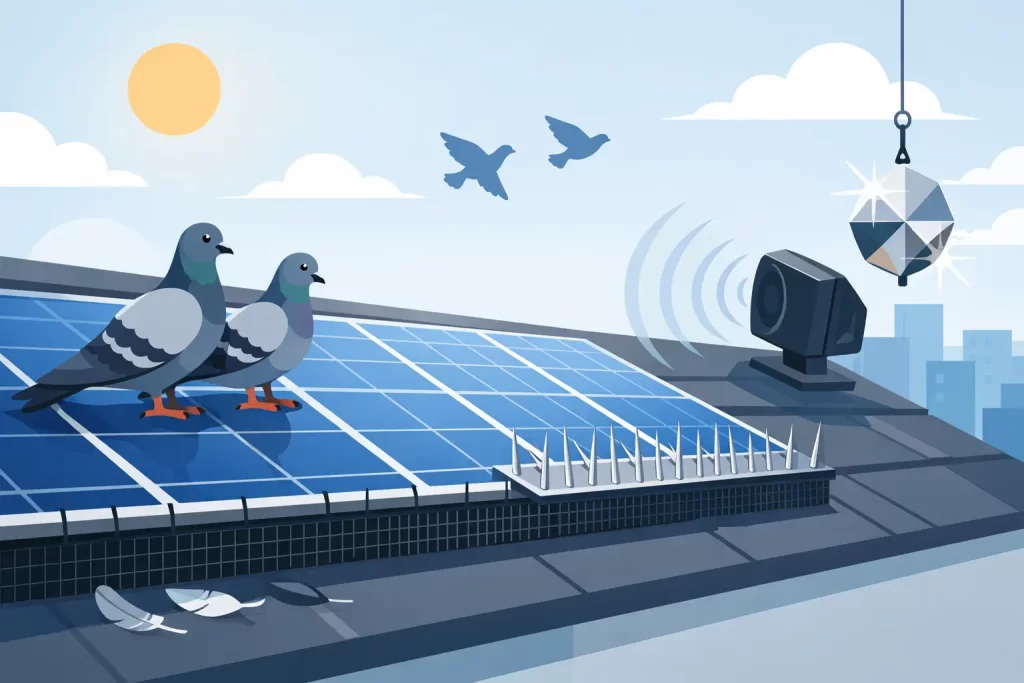
Pigeons do not simply sit on solar panels. They settle in the sheltered void beneath them, build nests, leave acidic droppings across the array and gutters, and pull debris towards cables and drainage points. For homeowners dealing with this problem, the best solar panel pigeon deterrents are the ones that physically deny access without damaging the panels, roof or mounting system.
The right solution is rarely a cheap visual scare device or a strip of spikes fixed where it happens to fit. Proper pigeon proofing needs to account for the panel layout, roof covering, cable routes, existing contamination and the condition of the solar installation itself. Done well, it protects generation, reduces mess and stops a small nuisance becoming a costly remedial job.
What Makes the Best Solar Panel Pigeon Deterrents?
A good deterrent should stop birds entering the space beneath the panels, rather than merely encouraging them to move along the roof for a few days. It must be secure in wind and weather, allow airflow around the array and avoid drilling into solar frames or roof tiles.
For most domestic solar PV systems, professionally fitted solar panel mesh is the most reliable answer. The mesh is fixed around the perimeter of the array using purpose-made clips designed for the panel frame. This closes off the nesting space while keeping the installation intact and accessible for future maintenance.
The material matters. Thin, poorly galvanised mesh can rust, deform or be pushed out of position. Cheap clips can loosen, scratch frames or fail after a season of wind loading. A proper installation uses durable, corrosion-resistant mesh and secure fixings selected for the specific panel frame, roof shape and gap beneath the array.
Just as importantly, pigeon proofing should not trap birds inside or seal in an existing nest, droppings and debris. The area must be inspected and cleared correctly before the perimeter is protected.
1. Solar Panel Mesh: The Most Effective Long-Term Option
Solar panel mesh is the leading choice because it addresses the root cause: access. Pigeons favour the dark, protected space below panels because it is warm, sheltered from rain and difficult for predators to reach. Once that space is closed off, they need to find somewhere else to roost.
A correctly installed mesh system follows the outer edge of the array and accommodates the awkward details that are often missed by general roof cleaners or handymen. These include changes in roof level, panel brackets, flashing, cable entry points and gaps at the ends of rows. Leaving even one useful opening can allow pigeons to continue nesting underneath.
Mesh is also discreet when it is colour-matched and fitted neatly. From ground level, a professional installation should not make a well-kept roof look patched together. More importantly, it should not interfere with the panels’ ventilation or their normal operation.
There is one condition: mesh must be installed after the contamination has been dealt with. Fitting it over an active pigeon problem locks in nesting material, feathers and droppings, which can create odour, insect activity and blocked drainage beneath the array.
Why professional fitting is worth it
Working around solar panels involves more than getting onto a roof. Panels, mounting rails, DC cables and tiles can all be damaged by incorrect access or improvised fixings. A specialist understands where the system can and cannot be handled, how to avoid stressing panel frames, and how to leave the roof watertight.
This is particularly relevant where an installation has been poorly fitted in the first place. Loose cables, broken clips, cracked tiles or panels sitting unusually close to the roof can all need attention before pigeon proofing is added. Covering a fault with mesh does not correct it.
2. Bird Spikes: Useful in the Right Place, Not Under Panels
Bird spikes can be effective on ledges, parapets, chimney pots, gutters and roof ridges where pigeons regularly perch. They make it uncomfortable for birds to land and can reduce fouling in a targeted area.
They are not, however, a complete solar panel pigeon-proofing solution. Spikes fitted at the panel edge do not reliably close the gap below the array. Pigeons can enter from another side, nest around the spikes or use them as a platform where they have been poorly positioned.
Spikes may be useful alongside mesh where there is a particular landing point next to the panels, such as a chimney or ridge line. They should be treated as a secondary measure, not a substitute for exclusion mesh. Plastic spikes and adhesive-only products are especially prone to failure in British weather.
3. Bird Netting: Effective, but Usually Less Suitable for Solar Arrays
Netting can exclude birds from larger spaces and is widely used on commercial buildings, canopies and agricultural structures. On a domestic roof, it is often harder to fit neatly and safely around a solar array.
Loose or poorly tensioned netting can sag, collect leaves and become a hazard for wildlife. It can also make panel access difficult when an engineer needs to inspect a fault, replace an inverter-related cable or carry out maintenance. For a straightforward residential array, rigid mesh fixed to the panel perimeter is normally cleaner, stronger and easier to maintain.
Netting can still have a place on unusual properties, especially where a large roof structure creates a wider bird-access issue. It needs careful design and proper installation, not a roll of netting tied to whatever is available.
4. Visual, Sonic and Scent Deterrents: Temporary at Best
Reflective tape, plastic birds of prey, ultrasonic devices and scented gels are often marketed as quick pigeon deterrents. They may disrupt birds briefly, especially when first installed, but pigeons are highly adaptable. Once they learn that the device presents no genuine threat, they return to the same sheltered nesting site.
These products do not block access beneath the panels, remove nest material or protect cables. They can also look untidy on a domestic property and create another item to maintain. For a homeowner trying to protect a valuable solar investment, they are rarely money well spent.
If pigeons are already nesting beneath the array, physical exclusion after professional cleaning is the dependable route. Scare tactics are not a lasting repair.
Clean Before You Proof the Panels
Pigeon droppings are more than an appearance issue. Heavy build-up can shade parts of a panel, restrict water flow into gutters and contaminate the roof area below the array. Nesting material holds moisture and may conceal damaged cables, displaced tiles or broken panel clips.
Cleaning needs to be carried out with suitable roof access and solar-safe methods. Aggressive pressure washing, scraping around cable runs or walking directly on panels can cause damage that is far more expensive than the original bird problem. There may also be health risks associated with dried droppings and contaminated nesting waste, so this is not a job to approach casually.
A proper remedial visit should include an inspection of the panel edges, frames, visible wiring, mounting system and roof covering before mesh is fitted. If generation has dropped, it is sensible to check the system’s output history as well. Not every performance issue is caused by pigeons, but contamination and shading can certainly contribute.
Consider Wildlife and Timing
Bird control should always be handled responsibly. If there are active nests, eggs or young birds present, the work may need to be timed or managed differently. Do not simply block an occupied nest or attempt to remove it without considering the welfare and legal position involved.
A specialist can assess what is happening beneath the array and recommend the safest practical route. Acting early, before nesting becomes established, gives you more options and avoids an unnecessary escalation.
Choosing a Pigeon-Proofing Installer
The quality of the installer matters as much as the mesh itself. Ask how the mesh will be fixed, whether drilling is required, what material is being used and how existing droppings or nests will be handled. You should also establish whether the installer understands solar PV systems, not just general pest control.
Be cautious of quotes based solely on a photograph from the ground. A roof-level inspection may reveal panel gaps, damaged tiles, cable issues or access constraints that change the scope of work. The cheapest quote can become expensive if the contractor bends frames, cracks tiles or installs mesh that fails in the first strong wind.
Safer Solar UK approaches pigeon proofing as part of solar aftercare: protect the roof, safeguard the electrical system and leave the array in a condition that can be maintained properly.
Pigeons will keep returning while the space beneath your panels remains an easy home. Close that space properly, clear the contamination safely and your solar system can get back to doing the job it was installed for.