
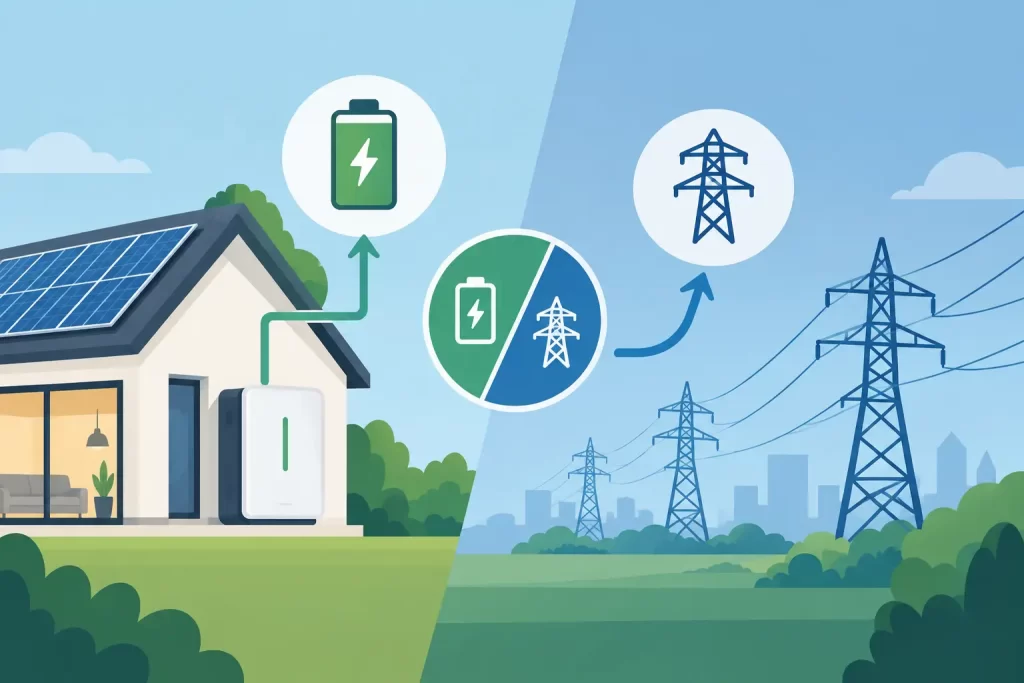
A sunny afternoon can make an older solar system look highly profitable on paper while the household is still buying expensive electricity after tea. That is the real question behind solar batteries vs feed in tariff: should you keep exporting as before, or store more of your own generation to use later?
For many UK homeowners with legacy Feed-in Tariff payments, the answer is not simply “fit a battery”. Your tariff type, export arrangement, household demand, inverter condition and the quality of the proposed installation all matter. Get those details wrong and a battery can be a costly addition that does not deliver the savings you expected. Get them right and it can make an established solar PV system far more useful.
Solar batteries vs Feed-in Tariff: the key difference
A Feed-in Tariff, usually shortened to FiT, was paid to eligible solar owners for electricity generated by their system. The scheme closed to new applicants in 2019, but many existing installations still receive payments. Most FiT households receive a generation payment for every unit their panels produce, plus an export payment for electricity sent to the grid.
A solar battery stores surplus power instead of sending all of it away immediately. That stored energy can then run appliances in the evening, overnight, or during low-generation periods. The financial benefit comes mainly from avoiding the cost of importing electricity from the grid, which is often much higher than the payment received for exported solar.
That sounds straightforward, but FiT export payments work in more than one way. Some older systems are paid for “deemed export”, commonly calculated as 50% of total generation rather than measured exports. If that is how your account works, installing a battery will generally not reduce the export element of your FiT payment, because it is based on an assumed figure.
Other systems have metered export. In that case, sending less electricity to the grid can mean receiving less export income. A battery may still be worthwhile because each stored unit can offset a higher-priced imported unit, but the calculation must be based on your actual figures, not a sales pitch.
When a battery usually makes financial sense
A battery is most useful when you generate electricity at times you do not need it, then import electricity later. A typical working household may export heavily between late morning and mid-afternoon, before using most of its power from 5pm onwards. Storage bridges that gap.
The value rises where electricity import prices are high and the household can regularly use the stored power. Evening cooking, washing, dishwashers, home working, electric heating controls and an electric vehicle can all change the picture. It also helps where a household has a time-of-use electricity tariff and can charge a compatible battery more cheaply overnight, provided the system is designed and configured properly.
However, a battery should not be sized by guesswork. A large battery can look impressive on a quotation but spend much of the year underused, particularly on a small solar array. A very small unit may fill before midday in summer and leave too much power exporting. Good design starts with generation records, import data, export data where available, and an honest assessment of how the home uses electricity.
The value is in avoided imports, not just stored solar
If your export payment is low and your import rate is considerably higher, using a solar unit at home is normally more valuable than exporting it. But battery losses need to be allowed for. No battery returns every unit put into it. Energy is lost through charging, discharging and conversion, so a claimed saving based on 100% efficiency is not credible.
You should also consider the battery warranty, usable capacity, expected cycles and replacement cost over the lifetime of the system. The cheapest unit is not automatically the best value if it has limited usable storage, weak aftercare or poor compatibility with your existing inverter.
When protecting your FiT position comes first
For some homeowners, a high legacy generation tariff is the most valuable part of the system. The good news is that a properly designed battery addition does not normally remove entitlement to an existing FiT generation payment. The concern is not the battery itself. It is poor paperwork, unsuitable equipment or an installer who does not understand how an older accredited system is recorded and paid.
Before authorising work, establish whether you are on deemed or metered export, retain copies of your FiT documentation, and check what your FiT licensee requires to be notified about. If equipment changes affect metering, export arrangements or the way the battery is charged, the details need to be clear from the outset.
Be particularly cautious with promises that a battery can be charged from the grid overnight and exported later for easy profit. Export arrangements, tariff terms, metering and battery settings all need to be compatible. A responsible installer will explain what the system will do, what it will not do, and how it will be commissioned.
Your existing solar equipment may decide the answer
Many FiT-era systems are now more than a decade old. Before adding storage, inspect the inverter, isolators, cabling, consumer unit connection and panel performance. There is little sense attaching a new battery to a system with an inverter near the end of its life, damaged roof penetrations, recurring fault codes or panels losing output through heavy contamination.
In some cases, an AC-coupled battery can be added alongside the existing solar inverter. This can be a practical route where the PV system is still sound and the homeowner wants minimal disruption. In other cases, replacing an ageing inverter with a hybrid inverter produces a cleaner long-term setup. Neither option is automatically right. Compatibility, warranty implications, installation layout and future expansion plans should drive the decision.
A competent survey should also identify whether the property needs Distribution Network Operator approval or notification. This is not paperwork to be ignored. Batteries and inverters can export to the grid, and the connection must meet the relevant requirements. Work should be installed, tested and documented correctly, not added as an afterthought beside the consumer unit.
Do not overlook underperformance
A battery cannot create generation that your panels are failing to produce. Moss, lichen, bird fouling, nesting activity beneath panels, inverter faults and shading can all reduce yield. Pigeons can also damage cables, contaminate roof areas and create a hygiene problem that worsens over time.
If your generation has fallen, deal with the cause first. A professional diagnostic visit can confirm whether the issue is dirt, degradation, shading, a failed optimiser, an inverter fault or poor previous workmanship. Cleaning, pigeon proofing, repairs and inverter replacement may restore output more effectively than adding storage to an underperforming array.
A practical way to make the decision
Start with a full year of figures if possible. Compare annual generation with imported electricity, exported electricity and your current tariff rates. Then look at the timing: how much power leaves the property during daylight hours, and how much is bought back in the evening?
Next, confirm your FiT arrangement. If you receive deemed export, calculate the likely reduction in grid imports from a battery without assuming your FiT export payment will change. If you have metered export, compare the value of a unit exported with the cost of a unit imported later, allowing for battery losses.
Finally, assess the condition of the solar system before choosing battery capacity or technology. A proper proposal should set out the expected operating behaviour, not just quote a headline storage size. It should also explain warranties, safety equipment, electrical certification, monitoring and who will deal with a fault after the installation is complete.
A battery is best treated as part of a well-maintained energy system, not a box that fixes every problem. When the panels are generating properly, the inverter is healthy and your FiT position has been checked, storage can turn more of your own sunshine into useful electricity after the sun has gone down.