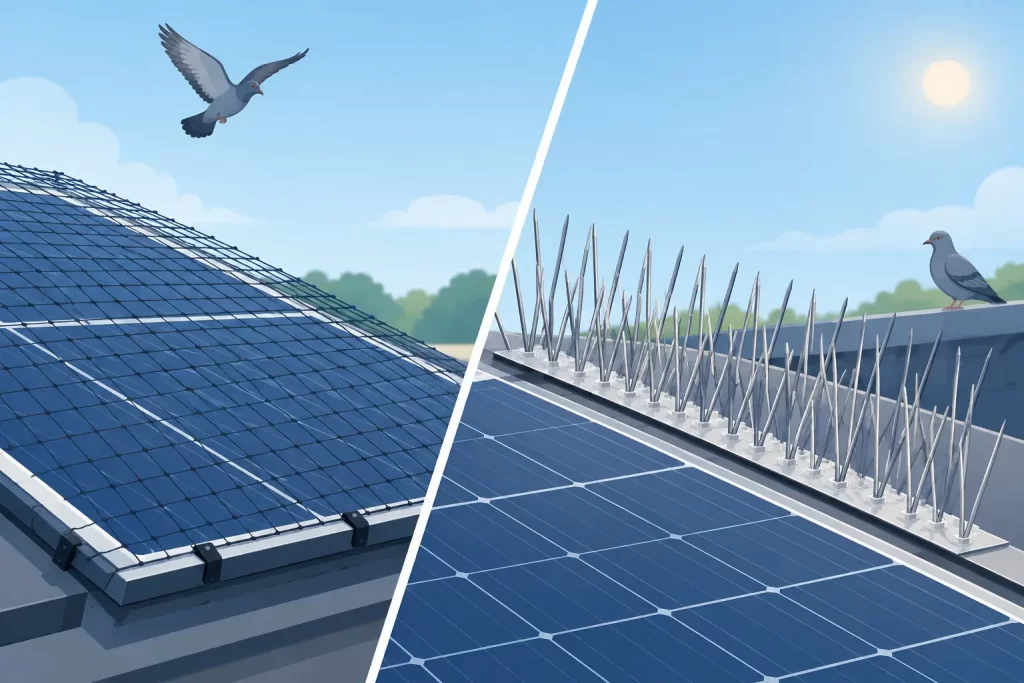
Pigeons do not need much room to turn the gap beneath a solar array into a nesting site. Once they are established, the problem is rarely limited to noise. Droppings build up on panels and roof coverings, nesting material blocks drainage routes, and persistent bird activity can affect cables, mounting components and the condition of the roof below. When comparing bird mesh vs bird spikes for solar panels, the right answer is usually determined by one question: are you trying to stop birds landing, or stop them getting underneath the panels?
For most residential solar PV systems, purpose-made bird mesh is the proper long-term solution. Spikes have a role in bird control, but they are often used in the wrong place by general contractors who do not understand how a solar array is built. A cheap-looking fix can leave gaps, damage the panel frame, create a future maintenance problem or simply move the pigeons a few inches along the roof.
Bird mesh vs bird spikes: the key difference
Bird mesh creates a physical barrier around the perimeter of the solar panel array. It prevents pigeons and other birds from entering the sheltered void beneath the panels while allowing ventilation to continue. Correctly fitted mesh follows the outline of the array and is secured using approved clips, rather than screws or drilled holes in the panel frame.
Bird spikes are strips of wire prongs designed to make a narrow ledge uncomfortable for birds to land on. They are commonly seen on signs, window ledges, gutters and chimney details. Their purpose is deterrence at a landing point, not enclosure of a larger protected space.
That distinction matters. A solar array has a long, continuous edge and a cavity beneath it. If pigeons can enter at any point, they can still nest under the panels. Spikes fitted along the lower edge may reduce landing attempts in one area, but they do not reliably seal the perimeter. They can also collect leaves, feathers and nesting material if the birds persist.
Why mesh is usually the better solar panel solution
A properly specified solar bird-proofing mesh deals with the cause of the issue: access. Pigeons favour the space under panels because it is warm, elevated and sheltered from rain and predators. Denying access means they need to find somewhere else to roost and nest, without altering the way the system is intended to ventilate.
Quality mesh should be durable, UV-resistant and corrosion-resistant. The fixings are equally important. The installer should use non-penetrating clips designed for solar panel frames, not self-tapping screws, adhesive blobs or cable ties pulled tight around electrical cabling. Panels expand and contract with temperature changes, and the mounting system needs to remain accessible for future inspection or repair.
Mesh also produces a cleaner finish when it is fitted well. From ground level it should sit neatly against the array rather than sagging, bowing outward or leaving obvious entry points at corners. The goal is to protect the system without compromising its appearance or making future maintenance more difficult.
For homeowners concerned about generation, mesh solves an indirect but significant performance issue. Birds nesting beneath panels can deposit droppings across the modules and encourage repeated soiling in the same area. Heavy contamination can reduce light reaching the cells. It may also create staining that becomes harder to remove if it is left through warmer weather.
Mesh is not a licence to ignore an existing problem
Installing mesh over active nesting activity without inspection is poor practice. Before work begins, the array and roof should be assessed for nesting material, eggs, chicks, damaged tiles, loose wiring and accumulated debris. Active wild bird nests may be protected, so timing and the method of work matter.
Once it is appropriate to proceed, the area beneath the panels should be cleared carefully and the roof condition checked before the perimeter is sealed. Simply fitting mesh around piles of droppings and nests locks the hygiene issue in place. It can also obstruct drainage and leave an unpleasant smell around the property.
Where bird spikes can still make sense
Bird spikes are not useless. They can be effective as part of a wider bird-control plan where pigeons repeatedly land on a narrow feature near the solar system. For example, a ledge, parapet, chimney edge or sheltered gutter line may be an attractive perch from which birds access the roof.
In those cases, spikes may discourage birds from using that particular landing point. They should be fitted only where they are suitable for the surface and where they will not interfere with gutter flow, roof access or future maintenance. They are a supplementary measure, not a substitute for panel perimeter mesh.
Spikes can also be a poor choice on the panel frames themselves. Poorly attached strips can work loose in wind, scratch the panels, look unsightly and make cleaning more awkward. Any attempt to glue or mechanically fix them directly to modules or frames should raise concerns. Solar panels are not generic roofing sheets, and their frames should not be treated as a convenient surface for improvised pest control.
The hidden risks of cheap pigeon proofing
Homeowners are often offered a low price for bird proofing after pigeons have already made a mess. The temptation is understandable, particularly if the installer promises a quick same-day fix. But this is one area where workmanship matters more than a fast visual result.
A poor installation may leave open corners, gaps around conduits or loose mesh that birds can push behind. It may trap debris against the roof, use steel components that corrode, or restrict access needed when an inverter fault, cable issue or panel replacement needs attention later. Some installers also fail to check whether the panel clamps, roof tiles and wiring have already been affected by bird activity.
There is a safety issue too. Solar work involves working at height and operating around live DC cabling. The person fitting pigeon proofing should understand the array, use safe access equipment and avoid putting weight on panels or disturbing electrical connections. A general handyman may be able to attach mesh, but that does not mean they can assess the condition of the solar system beneath it.
Choosing the right approach for your roof
The best solution depends on the layout of the array and the scale of the bird problem. A simple rectangular array with clear access is normally straightforward to mesh. Split arrays, panels around roof windows, complex cable routes and damaged roof coverings require more planning. The installer should measure the full perimeter, inspect the underside where possible and identify every potential access point before materials are fitted.
Ask what the mesh is made from, how it will be attached and whether the quote includes clearing debris beneath the panels. It is also worth asking how future panel servicing will be handled. A professional installation should be secure but removable without damaging the panels or their frames.
If bird droppings are already visible on the glass, arrange cleaning as part of the remedial work where appropriate. Cleaning the panels before access is blocked helps restore their appearance and allows the installer to see whether there is persistent staining or damage. Do not use harsh chemicals, abrasive tools or pressure washing on the array. These methods can cause more harm than the dirt itself.
Protect the system, not just the view
The strongest solar bird-proofing jobs are rarely the ones that rely on the most visible deterrent. They are the ones that inspect the roof properly, remove the cause of the contamination and use materials that protect the solar installation for years rather than a single season.
For a homeowner with pigeons beneath their array, mesh is generally the sensible first choice. Spikes may help control nearby perches, but they cannot reliably secure the sheltered space that pigeons want most. If the system has already been affected, have it assessed by a specialist who understands roofing, solar PV and safe remedial work. A tidy perimeter is useful; a protected, serviceable and properly functioning solar system is the result that matters.